


 17 / 100

February 2016
17
Down to detail
Antennas would prove to be the key to this
operation – the location was not exactly
at
the sea edge, but above it. This meant that
our VDAs from TX6G would not be suitable
as, at that elevation, they would not give
the necessary low-angle lobes. Modelling
by Mike, G3WPH and David, G3WGN
suggested that high inverted Vee dipoles
would work best on HF, with verticals for
LF. Measurements using Google Earth gave
us the length of our cable runs to allow for
maximum flexibility of antenna positioning.
We needed long runs of low loss cable and,
in the end, this took up a lot of our baggage
allowances.
We would again take Elecraft stations –
K3/K3S and KPA500. Through the kindness
of Olof, G0CKV, we were also lent an SPE
Expert 1.3 that would add some clout to
our LF signal on 160 particularly. Over the
whole expedition, we had no equipment
failures, despite everything running in a
non-air conditioned environment. But the
shacks were well ventilated with large
openings letting a lot of air (and mosquitos!)
into the rooms. Night time was particularly
challenging for operating and we all ended
up being fully clothed and covered up for the
night shifts.
We decided that as the twice-weekly
flights to Niue from Auckland are by Airbus
320, with few weight constraints, we would
invest in some 18m Spider-poles and try
to get an extensive
antenna
farm
assembled on the
island. In the end,
we found ourselves
taking some 400kg
of baggage through
a combination of Air
New Zealand, BA and Emirates, each team
member choosing his ‘favourite’ routing to
Auckland. Most flew business class, which
offered a whopping 69kg of checked baggage
per person on Air New Zealand and BA.
Making it happen
The team assembled in Auckland two
days before the flight to Niue. Then, on 16
September, we presented Air New Zealand
with our 400kg of baggage and boarded for
the three and a half hour flight. Our on-island
contact Frank had a minibus and car ready
and, after stopping at the supermarket for
crates of water, beer and other essentials, we
were on-site by mid-afternoon.
We had not planned on the pretty basic
nature of our living accommodation. The
owner had warned ‘nothing fancy’ and
it was a traditional island house. Three
bedrooms (one used as a store), kitchen/
diner and lounge, together with bathroom. It
was not designed to sleep seven people so
mattresses had been provided that we put
on the concrete floor of the house. In the
end it did not really matter – it was dry, it
had the sleeping facilities, a hot shower and
a washing machine. It also had mosquito
nets on the louvered windows, which was
essential.
We had arranged for all catering to be at
the operating location, which turned out to
be ideal with its large sheltered veranda. We
did not know what to expect in terms of food.
The first evening on Niue we were presented
with a ‘banquet’ with an enormous variety of
meats, vegetables and desserts. We politely
asked that future meals should be scaled
back a bit, and had to repeat the request
several times subsequently – our waistlines
suffered badly!
We chose a very modest target for day
1, and simply erected the HF antennas
and installed all the stations and computing
equipment. There was limited operation on
Feature
Don Beattie, G3BJ
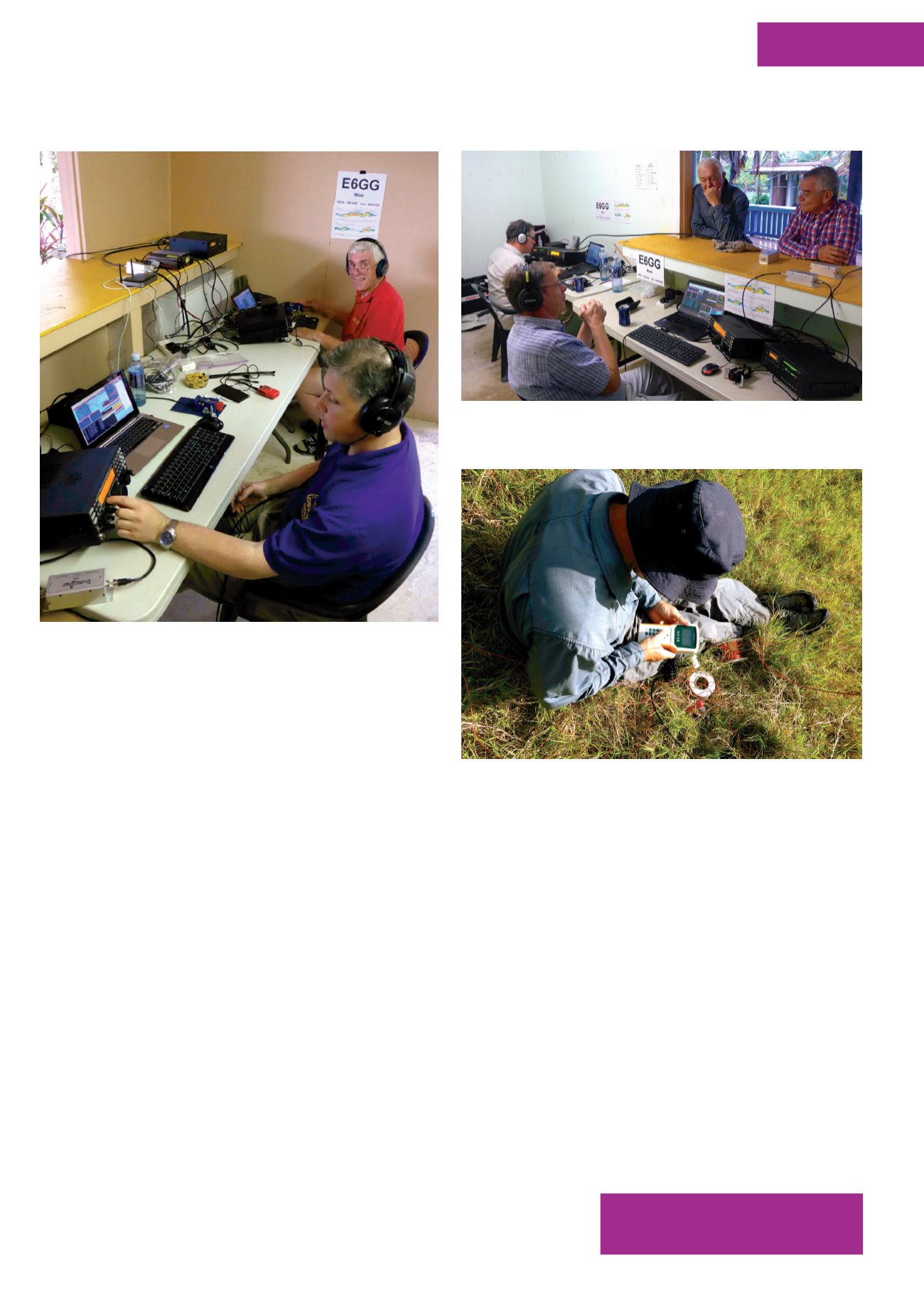
don@g3bj.comG3TXF (top) and G4TSH in one of the operating rooms. Photo courtesy of
Hilary, G4JKS.
Mike, G3WPH, adjusts the resonance of the 160m Tee antenna. Photo
courtesy of Hilary, G4JKS.
David G3WGN, Chris G3SVL, Mike G3WPH and Don G3BJ at one of the
operating rooms. Photo courtesy of Hilary, G4JKS.