


 22 / 100

February 2016
Review
22
revolution. 5Hz steps are also selectable on
SSB/CW/data, 100Hz is the step size on FM/
C4FM and a Fast button increases all these
by a factor of 10. Channel step tuning in a
variety of step sizes using the MULTI control,
direct keypad frequency entry and tuning
from the microphone are also all provided.
Twin VFOs (A/B) allow split operation with
ability to easily check and tune the transmit
frequency via TXW. Receive and transmit
clarifier, pitch control and auto-tuning on CW
are all included.
There are a total of 99 regular memories
plus 5MHz channels, band edge channels
for scanning, home channels and five quick
memory bank stores. Memory channels are
easy to access and display with tag names
up to 12 characters in length. The usual
band and memory scanning functions are
also provided.
Two mode-specific settings for the IF
channel bandwidth, wide or narrow, can
be selected from the touch screen. These
are settable over wide limits for SSB, CW
and data modes but are fixed for AM and
FM modes. The passband can be adjusted
using width and shift and Yaesu’s contour
control function is included as used on its
larger radios. An adjustable noise blanker, a
tuneable IF notch, an auto-tuning multiple
beat notch and a digital noise reduction
system are all provided to assist in combating
noise and interference. The receiver audio
response can be tailored independently for
each mode with the high pass and low pass
roll-offs adjusted separately and a CW audio
peak filter is provided. Three AGC speeds and
OFF may be selected for each mode, except
on AM and FM (contrary to the manual) that
are fixed but show OFF on the display, which
is incorrect.
Transmit functions for SSB include
the usual speech compressor, VOX and a
transmission monitor. The overall audio
bandwidth may be tailored and a three-band
parametric microphone equaliser allows
wide adjustment of the audio characteristic.
Separate settings for speech processor on
and off are also provided. On CW there is the
usual provision for full and semi break-in and
the drop back delay is adjustable but only via
the menu, a possible candidate for the C.S
button. The built-in auto ATU operates on all
bands from 160 to 6m, matching up to 3:1
VSWR, and has 100 memories for storing
the most recently used transmit frequencies.
On FM, a full range of selective calling
and repeater access facilities are provided
including CTCSS tone squelch, DCS digitally
coded squelch, 1750Hz tone burst and
DTMF codes when used with the optional
MH-36 microphone. Repeater duplex offsets
are stored separately for each band and are
programmable over wide limits.
Auxiliary features
A full CW message keyer is included operating
over the speed range 4 - 60 WPM with
adjustable weighting and a variety of keying
paddle arrangements. Five memories will
each store up to 50 characters with a provision
to send automatically incrementing serial
numbers and auto-repeat after a time delay
(beacon mode). The message stores may be
programmed either by sending code using the
keying paddle or in text via the touch screen
display. Messages may be transmitted either
from display buttons or more conveniently
using the external FH-2 keypad.
The radio also includes a voice memory
for transmitting voice messages such as
CQ calls. There are five memory channels
available each capable of recording 20
seconds of audio. As with the CW keyer
messages may be transmitted either from
display buttons or from the FH-2 keypad.
A scope function is provided that is quite
comprehensive in a radio of this size. It
provides a spectrum display or a waterfall
display of the band either side of the receive
frequency with a range of selected scan
widths. The scope can be set to scan once for
each press of the sweep key, continuously, or
every few seconds and the receiver is muted
during the scan. In addition it can perform
a scan when the main dial is rotated above
a certain speed but I found this distracting
and best to disable. The waterfall is only
meaningful in continuous scan mode.
The radio is also capable of using two of
the C4FM digital modes, the V/D mode and
the Voice FR mode. V/D mode communicates
voice and data simultaneously, allocating
half the channel bandwidth to each. Voice
FR mode transmits higher quality digital
voice data over the full channel bandwidth
of 12.5kHz. The radio can also intelligently
and seamlessly switch between FM and
C4FM modes as appropriate according to the
received signal. This is the AMS (Automatic
Mode Select) function. The radio also
supports the GM function (group monitor)
where the position and distance for each
callsign within range for registered group
members are displayed on the screen. A
suitable external GPS unit can be connected
to the radio and the latitude and longitude
data can also be entered manually.
Measurements
The full set of measurements is given in the
table. Sensitivity is excellent, particularly
on the quieter bands with preamp-2 in
circuit. Preamp-1 is disabled below 1.8MHz
although surprisingly the higher gain
preamp-2 remains in circuit right down to
30kHz. Sensitivity on LF drops rapidly below
150kHz. The noise figure was measured as
about 6dB on 50MHz, 6.6dB on 144MHz
and 4.5dB on 432MHz. The S-meter
indicates about 2.5 to 3dB per S-unit and
maintains good linearity across the whole
range except on FM where it is somewhat
cramped above S9. The rejection of IFs and
images was outstanding, unmeasurable in
most cases over 120dB. The AGC attack
time was fast and clean with no hole in the
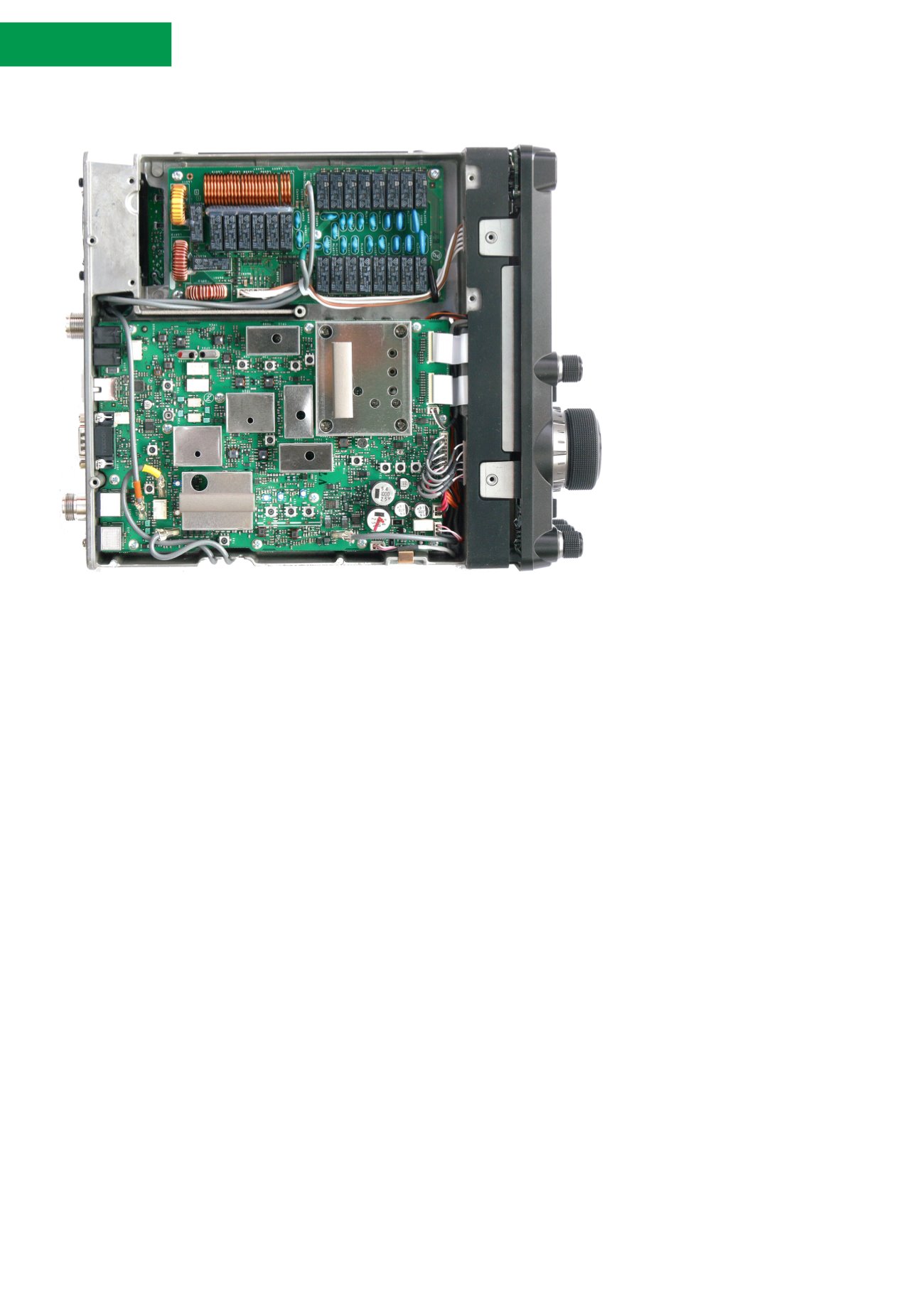
FT-991 underneath bottom cover showing main RF board and ATU.