


 24 / 100

February 2016
Review
24
response unlike most DSP-based systems.
The decay times were somewhat dependant
on level and somewhat shorter than the set
times but there is a vast range to choose from
(20ms – 4s).
The front end third order intercept and
dynamic range figures are good for a radio of
this type and price bracket and a significant
improvement over the FT-897. The dynamic
range deteriorates close in but not as much
as some other similar radios. Inband linearity
was good and the audio looked very clean.
Reciprocal mixing phase noise figures are
rather poor and similar to the FT-897 and this
means that the IF filter skirts tend to be masked
by noise below –60dB. Front end blocking
appeared to be very good but measurements
were limited by reciprocal mixing noise. The
overall selectivity and adjacent channel results
are shown in
Figure 1
.
The transmit power output was well up
to specification and the metered power level
accurate. On SSB, intermodulation products
were rather poor although the higher order
(wide band) products were reasonable. The
speech compressor worsened distortion
products slightly. On AM, carrier levels are
correctly set but the maximum modulation
depth is 60% and somewhat distorted.
On CW, the keying envelope was clean
with low distortion even at high speeds and
full and semi break-in gave the same results.
The rise and fall times were a little too sharp
at both the 4ms and 2ms settings. There
was no first character shortening or power
overshoot at any level. In full break-in it was
just possible to listen between dots at about
28 wpm. An adjustable delay to allow for
linear amplifier switching is provided and
this functions correctly when using the front
panel key jack. However, if CW is keyed via
the rear panel connector this delay is not
implemented in semi break-in mode and RF
output and linear amplifier switching occur
simultaneously, resulting in the amplifier
hot switching. There is no problem with full
break-in with either connector if the amplifier
switching time is less than 10ms and with
data modes, switching times are adequately
sequenced.
The wideband transmitter noise output is
rather poor, particularly on VHF. The 6m and
70cm figures are similar to 2m. At spacings
closer than 20kHz the noise equates closely
to the receiver reciprocal mixing figures and
hence is due to frequency synthesiser phase
noise. Further out it is probably due to
amplitude noise in the amplifier stages and
is independent of power level, even present
at zero power output.
On-the-air performance
I spent some time using this radio and this
included contest operations on 70cm, 160m
club calls and CQWW SSB. Overall I found
the radio easy to use and a good performer.
I like the ergonomics. The touchscreen is
clear, bright and positive in operation, bands
and modes are quick to select but finding
and selecting some of the paged functions
can be a bit elusive and tedious. Some of
these functions such as noise blanker, DNR,
keying etc need to be selected or deselected
separately for each band. The controls are
easy to access and the tuning is smooth and
well balanced although with relatively few
steps, FAST usually needs to be selected for
navigating the bands. The VFO-B/clarifier
rotary control has a lot of friction, presumably
to stop it being accidentally moved but was
particularly stiff in the review radio and has a
low tuning rate. For split frequency operation
it is much easier to use the main tuning drive
and TXW to set the transmit VFO.
The receiver performed very well, having
excellent sensitivity on the quiet bands and I
could find no trace of intermodulation on the
lower bands even with preamp-2 selected.
AM broadcast was clean but sensitivity at
the lower frequencies was much less. The
VLF timecode transmissions were well down
in the noise. The channel filters, notches,
noise blanker and noise reduction system
all performed extremely well. The noise
blanker completely eliminated clicks from
a nearby electric fence. The audio quality
and level from the internal speaker was
reasonably good but somewhat restricted
in bass response and resonances were
noticeable particularly on CW. The quality
on headphones was excellent.
On transmit the audio quality on
SSB using the MH-31 microphone was
excellent, receiving very complementary
reports. The audio settings were set to the
default values.
CW break-in was clean and full break-in
allowed listening between characters up to
quite high speeds. I did not check out the
data modes or C4FM. I am not currently
within range of a C4FM repeater. The
spectrum scope can be helpful but is rather
restricted in size. It is better than most in
this price bracket and seems fairly sensitive
with reasonable resolution. It is of course
limited as the receiver has only one signal
path and mutes the audio during a scan.
Conclusions
The FT-991 is an excellent all-round radio
for use from home or travelling and gives
access to all bands from 160m to 70cm. It
has a full set of features and functions for
HF to UHF and an excellent performance
within its price range. If driving a linear use
only the front panel keyer on CW. Priced
at around £1000 with current deals from
the usual suppliers it is very good value for
money. I would like to thank Yaesu UK for
the loan of the radio.
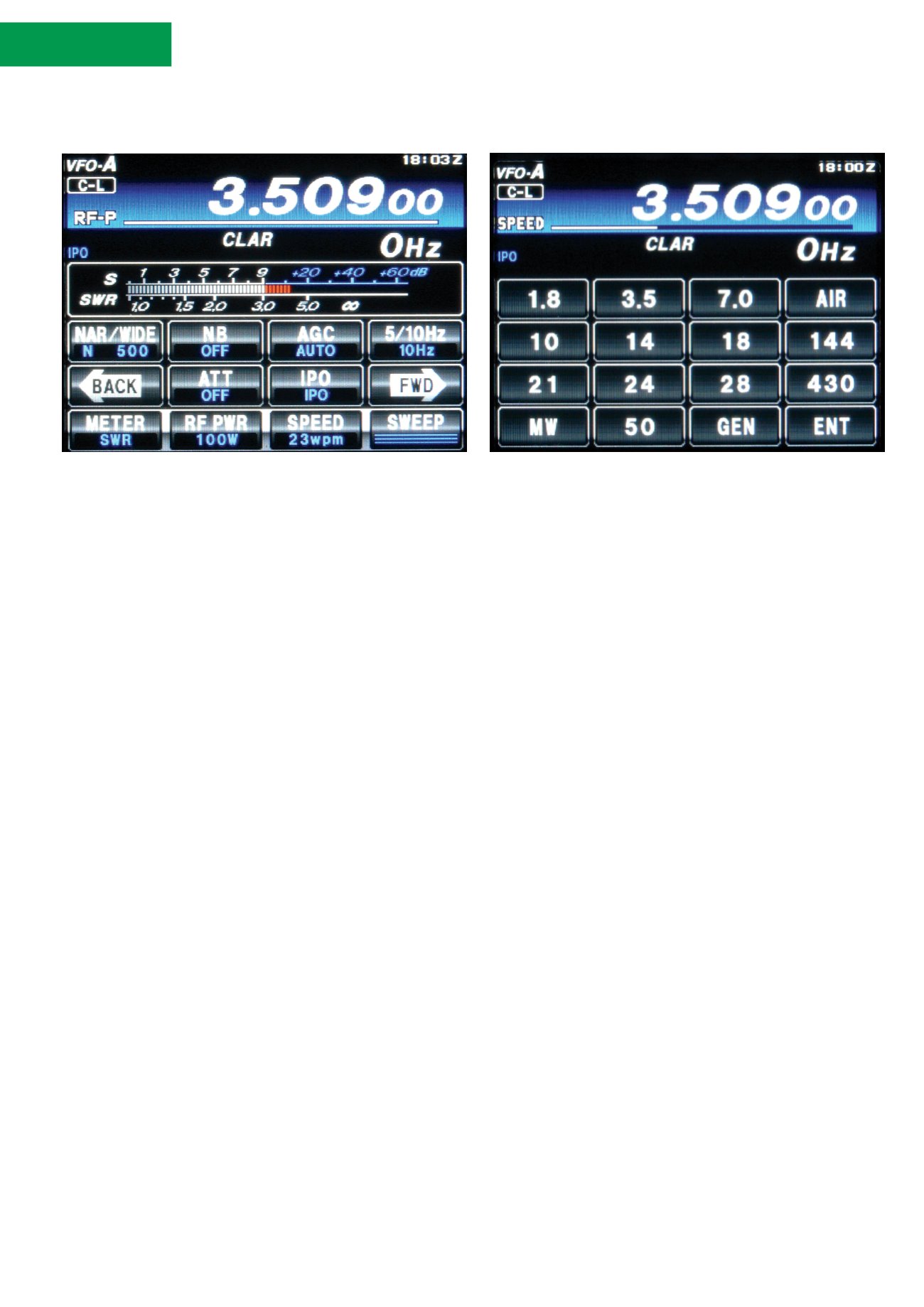
FT-991 touchscreen display showing one page of the function keys.
FT-991 touchscreen display showing band buttons.