


 27 / 100

C
oherent
signalling
experiments on 137kHz (and
lower) have been taking
place with some good success over
the last few months using
EbNaut
software written by a group of
amateurs determined to push the
weak signalling capabilities of the
bands to the limit.
The
EbNaut
software
[1]
is certainly not plug
and play; it requires that you have an intimate
knowledge of your signal structure, the format
and timing of the message and, for most users,
how to drive
Spectrum Lab
[2]
as well as the
innards and meaning of the terms used in
the driver and receiver software, and that you
agree in advance everything about the message
– except its actual contents, of course! Above
all, you need an accurate frequency source
based on GPS or rubidium locking and timing
on the PC accurate to 100ms. The latter can
usually be achieved with a network time setting
programme such as
rsNTP
[3]
.
How It works
Modulation is binary phase shift keying (BPSK),
but unlike previous amateur use of PSK, the
receiver does not attempt, itself, to recover carrier
or symbol timing. It assumes the transmitting
station is ‘good enough’. Typical symbols
rates used at 137kHz have ranged from 0.25
seconds per symbol to 2s, using messages that
last up to 20 minutes, so the carrier must not
drift by no more than would result in about 45
degrees of phase shift over this Tx period. 45
degrees in 20 minutes at 137kHz requires a
frequency stability of about one part per billion
– no big deal for a GPSDO or rubidium source,
but at the limit for even a good ovenned crystal.
The message is convolutional coded to
add a very high level of error correction. Basic
convolutional coding using two shift registers
(rate½) was described in this column in October
2015 in connection with WSJT. However,
EbNaut
uses eight or more feedback registers
for rate 1/8 or longer coding. It is this extreme
level of added redundancy that allows the
system to get within a dB of the Shannon limit
for some paths. In addition, an outer checksum
is added as a further check of correct decoding
as it is quite normal, and statistically inevitable,
that completely random noise will occasionally
get through the decoding process and generate
garbage messages.
Transmitting
The
EBNaut
encoder is relatively straightforward
to drive. It uses the PC clock for symbol timing,
so this has to be maintained accurately using
a time server or GPS. You specify the sub-
mode (the code rate and level of checksum
strength), the symbol period and the start
time. The symbols are generated and sent to a
transmitter by the simple expedient of toggling
the RTS and DTR lines on a COM port. It is up
to you how you use these to generate a 180°
phase shift; several operators have little more
than a changeover relay and centre tapped
transformer. Others (like myself) have adapted
DDS driver PIC code to reprogram the chip’s
phase shifter in response to an external input.
Others use diode ring mixers. However, note
that using a soundcard and upconversion is not
an option for this mode: as described before,
soundcards are just not good enough.
Receiving
This is where it gets complicated. The
EbNAutRx
software comes in two packages, compiled for
32 or 64 bit Windows (also available in Linux).
If you have a modern machine, use the 64 bit
version to speed the decoding process. It only
works offline, with .WAV files that have been
recorded and saved. Extreme frequency stability
means normal sound card recording is not stable
enough; another solution is needed. The first
thing you have to do is generate a properly timed
(and ideally time stamped) .WAV file of the
received audio. Using
Spectrum Lab
for this was
described briefly in the December Design Notes,
using GPS derived clicks added to the audio to
take out soundcard inaccuracy and drift. Custom
.WAV files with addition of a chunk labelled
‘inf1’ allow arbitrary sample rates, time stamp
and other information to be included. At ‘JNT
Labs, my homebrew 1kHz bandpass sampling
LF receiver (see January’s Design Notes) works
in conjunction with custom PC software to save
compatible low data rate .WAV files.
Run
EbNautRx
and browse to find the
recorded file. It is essential that the exact start
time of the recording is known so that any offset,
deliberate or otherwise, can be entered into the
start offset window (my recordings start one
second early by default). The message length,
symbol period and sub-mode are entered and
the decode started. Since the absolute phase
cannot possibly be known in advance, the
decoder has to search over a range of phases to
determine this – you can see it choosing settings
as the software runs. It is doing an enormously
complex computational task, so don’t be
surprised to see the CPU capacity at 100% ! It is
running thousands of Viterbi decoding sessions,
and matching checksums in order to get a valid
one. If you are fortunate, a message will soon
pop up after just a few percent of the overall
progress. Decoding even a short message can
easily take several minutes, so just leave it to get
on with the job. Even after a message appears,
it will go on searching for better solutions. All the
results are stored in an accompanying .TXT file
generated by the decoder.
If there is uncertainty in start times – like the
Tx station is a bit ‘out’ for example – multiple
instances of
EbNautRx
can be started in
parallel, all with identical parameters entered
apart from various offsets in start time. It may
take hours to run, but the chances are, if there
is a message to be decoded it
will
find it!
And finally…
An interesting paper by Pieter-Tjerk de Boer,
PA3FWM entitled ‘Signal/noise ratio of digital
amateur modes’ can be found at
[4]
. This
compares many of the weak signal data modes
we use routinely.
WEBSEARCH
[1]
EbNaut
–
http://abelian.org/ebnaut/The name
EbNaut
derives from the term Eb/No meaning
energy per bit, used as a normalised measure of signal
to noise ratio for digital communications systems.
[2]
Spectrum Lab
audio processing tool –
www.qsl.net/dl4yhf/spectra1.html[3]
Ridiculously Simple NTP Server
–
www.qsl.net/dl4yhf/rsNTP/rsNTP.htm[4] Signal/noise ratio of digital amateur modes –
www.pa3fwm.nl/technotes/tn09b.htmlAndy Talbot, G4JNT
ac.talbot@btinternet.comData
February 2016
27
Regulars
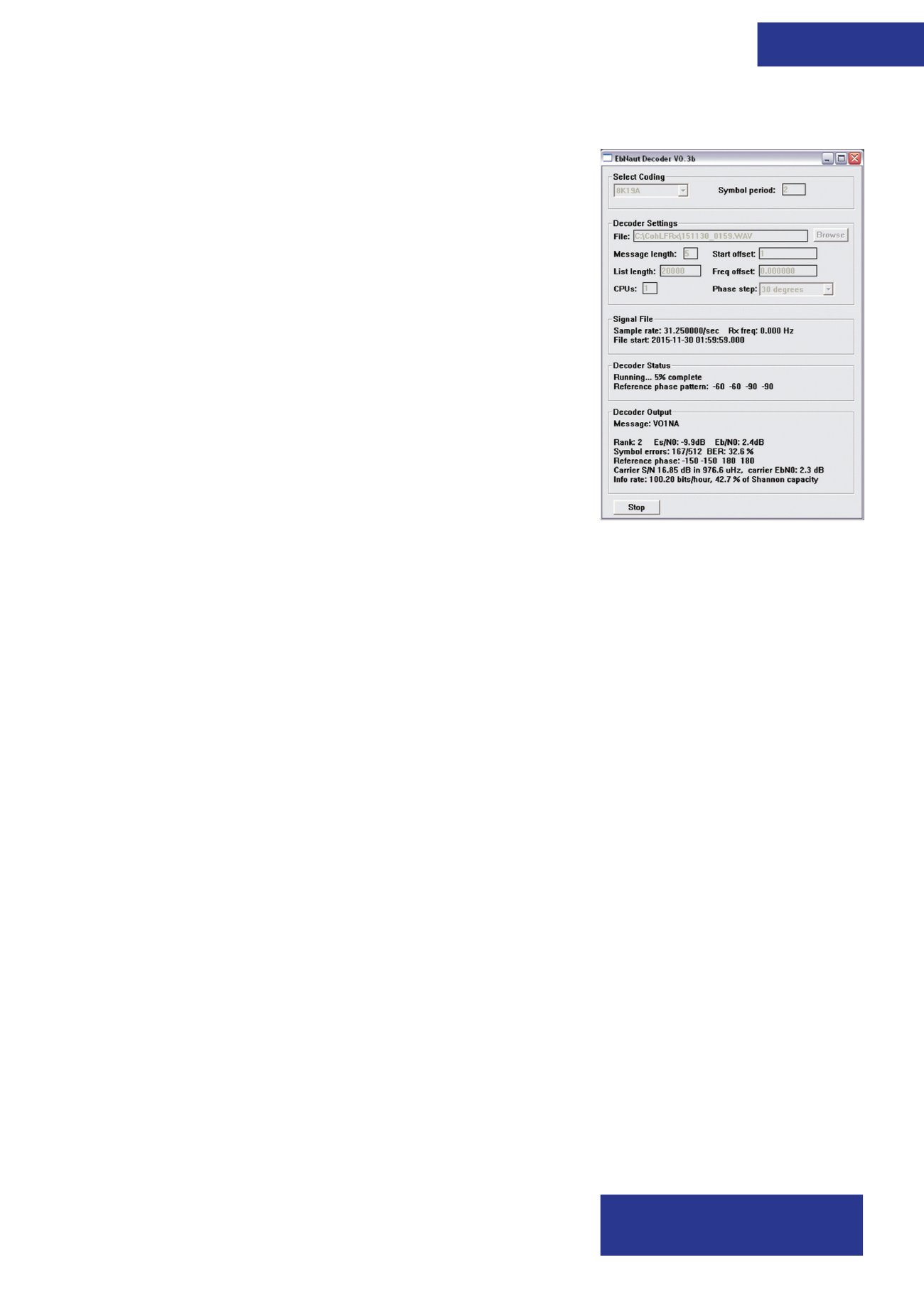
FIGURE 1:
The
EbNaut
receiver screen showing
a successful decode of VO1NA running about
20W on 137kHz.