


 18 / 100

February 2016
Feature
18
HF that evening. The following day was
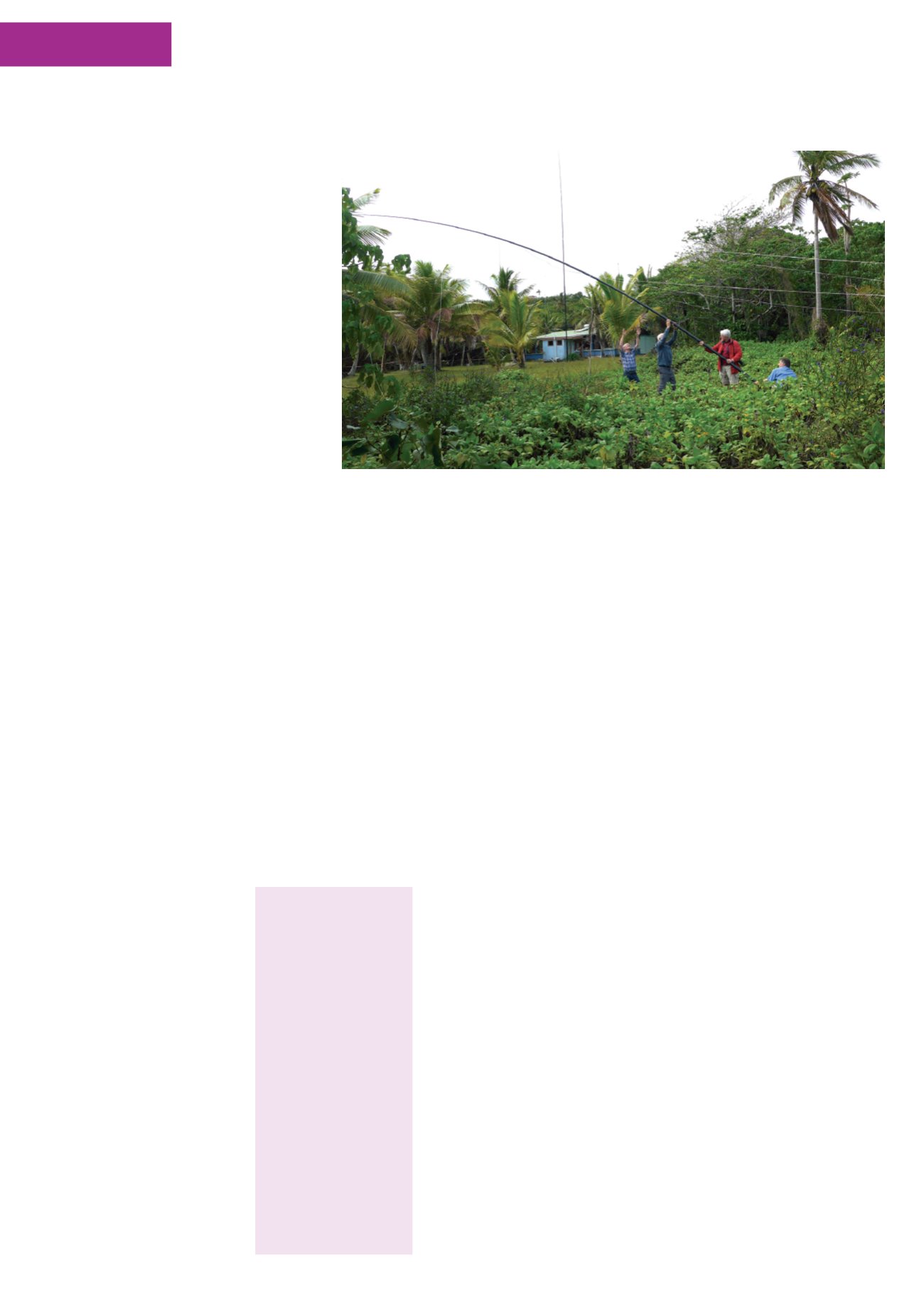
the day for big LF antennas. All the dipoles
went on the 18m Spider-poles and we put
up verticals for 40, 80 and 160. We had
planned to guy everything to rebar lengths
hammered into the ground, but this was a
non-starter as the ground was impossible
to penetrate. So we had to make use of
strategically placed palm trees to hold our
guys. We even put the 40m vertical up a
palm tree, to minimise guying needs. This
‘coconut vertical’ suffered a little from rain,
as the top made contact with the hanging
coconuts, with the inevitable results. We
used RFC400 cable for the longer HF cable
runs and were impressed by this relatively
cheap and low loss cable. For LF we used
Ultraflex and Aircell 5.
The bands
Conditions were at best variable. The first
day or so, things were pretty good, but then
a major solar event torpedoed the bands for
several days, with the A index up in the 40s.
This limited our HF QSO rates enormously.
We had in mind something around 50k
as a target for Niue (a much more difficult
path to Europe than the Australs), and with
dedicated stations on 80 and 160 overnight,
we carried quite an overhead in terms of
QSO rate. When propagation returned to
‘normal’, the last few days showed that our
antenna plans were spot-on. The European
HF signals were big, and we felt ‘loud’ in
Europe. It is just disappointing that we lost
a large number of QSOs from the poor initial
conditions and quite a few from a seven
hour ‘planned maintenance’ weekend power
outage.
Having dedicated antennas for each LF
band was the right strategy – in the end we
made over 1,000 QSOs on 160
and some 2,500 on 80m, with
peak openings coinciding on
each band, of course. Although
we worked Europe extensively
on 80, 160m EU QSOs were
limited to the Eastern part of
the continent. We tried every
day to the UK but it was not
to be. The issue was not one
of static, but simply of signal
level – we heard a few ‘pings’
on 160, but no G QSOs.
Our 160m operating was
based on being on the band
at Niue/European sunrise/
sunset and on following the
dawn terminator across the
US. This meant about seven
hours on the band each night
– often more. Encouragingly
the static levels were not
excessive – we could hear
between the crashes. Although we had
planned a Beverage, the land meant it was
hard to implement. We tried a Pennant, but
with little success. In retrospect perhaps a
K9AY would have helped, but we had the
clear impression that the limiting factor was
probably the strength of our signal in Europe,
which receiving antennas would do nothing
to improve.
We took some ‘stick’ for our focus on CW
at the start, but with conditions as they were,
CW offered the magic 15-20dB advantage
over SSB. SSB contacts would have been
hard, and rates low in those early days, and
pile-up control near impossible. Later in the
expedition we ramped up the SSB activity,
with large and very unruly pile-ups to
Europe. 17m RTTY operation was relatively
limited, reflecting the CQWW RTTY contest
on our second weekend, and the fact that
Chris, GM3WOJ had offered
a significant number of RTTY
QSOs when he had been on
the island.
The results
Our results show a total
of 48,635 QSOs with an
encouraging level of EU
contacts and the numbers are
shown in
Table 1
. Our uniques
percentage was nearly 32%,
which we regard as a good
outcome.
One disappointment was
our internet capability. There
was nothing at the operating
location, and at our house, it
was very slow. It was based
on the island public Wi-Fi that
shares a single 8Mb/s satellite
link amongst all the islanders.
To upload the logs, we took a twelve mile
drive to the capital, Alofi, where an internet
café seemed to have a somewhat faster
service. We had also planned to update the
E6GG.com website during the expedition,
but only managed it a couple of times.
Reflections
Our daily operating routine was established
with a five hour sleep slot each day and
six to nine hour operating periods. We had
three stations active at all times, and the
fourth (taken as a spare) in use when there
was someone to use it. We all managed
short island tours, but the pressure on the
QSO numbers limited our tourism. We did,
however, all get the opportunity to visit sea
caves and to see humpback whales as they
come close in to the island breaching out of
the water. We also had a visit from the New
Zealand High Commissioner on the island,
who seemed genuinely interested in our
expedition.
Farewell
The time passed in a flash. It seemed that
no sooner had we started operations than it
was time to close down. A cool dry day with
a light breeze allowed us to complete the
breakdown and packing in six hours, ready
for a final farewell dinner with our island
hosts. This proved to be a very light hearted
and touching evening, with a large amount
of good food and New Zealand beer being
consumed. Our new friends who had looked
after us so well were at the airport to say
goodbye and present gifts. As ever, leaving
Niue was sad – Hilary and I have a ‘soft spot’
for the tiny island with a huge heart. It is the
people that make an island and Niue is very
special in that regard.
Table 1: The results.
Continent
%
Oceania
2
Asia
29
South Africa 1
North America 37
Europe
30
Africa
1
Band (m)
% Europe
160
<1
80
13
40
19
30
44
20
50
17
42
15
27
12
4
10
<1
Mode
QSOs
CW
38.2k
SSB
8.8k
RTTY
1.6k0
The 20m antenna goes up. Photo courtesy of Hilary, G4JKS.