



 81 / 100

Regulars
February 2016
81
T
he QRP scene in Australia
and regenerative receivers
make for interesting reading.
Perhaps Australia may not always have been
regarded as a good source of QRP building
and operating, but two Australian radio
amateurs – Drew, VK3XU and Peter, VK3YE
– have been prolific in their writings on
practical amateur radio. For many years Drew
and Peter have produced straight forward,
no nonsense, practical projects capable of
being built by the average home constructor.
Drew has produced four volumes of
Radio
Projects for the Amateur
. Drew sums them
up as “Plans for the construction of receivers,
transmitters, antennas, and test equipment
plus handy workshop hints and tips”.
Drew designs the equipment and
writes the text with excellent hand-drawn
schematics plus layout diagrams and
photographs. The books (volumes 1 to 4)
are self-published with typesetting and
editing by Bill, VK3BR. Originally the books
were printed and available for sale within
Australia. Drew was kind enough to allow
the GQRP Club to produce their own prints
from the original typesetting and artwork.
These are available to GQRP Club members
as outlined on the website
www.gqrp.comor
the club journal,
SPRAT
.
Another great figure in Australian QRP is
Peter, VK3YE. Well known through a series
of YouTube videos, VK3YE has a world-wide
following. As Peter says, “the VK3YE YouTube
channel includes videos on QRP amateur
radio, simple electronics and antennas”. As
the editor of the GQRP journal
SPRAT
, it has
been my pleasure to bring many interesting
and exciting VK3YE projects to a wider
audience.
Now Peter has released a new ebook. I
found out about the book through the through
the G1KQH blog. Steve, G1KQH, has been a
long-time source of material for this column.
Steve writes, “The Master of the QRP Video,
Peter, VK3YE has launched a new ebook for
the Kindle titled
Minimum QRP
. The book
is available for purchase direct from Amazon
for a few pounds or dollars, or whatever
currency your country uses. Just search
‘Minimum QRP’”.
The book is written in the simple Peter
Parker methodical way, but if you still don’t
understand the book, don’t worry, you can
always refer back to his amazing back
catalogue of VK3YE video material on his
channel. If you like the VK3YE YouTube
output you will not be disappointed in the
book, there is something in it for everyone
from the novice to the converted. Further
details from the VK3YE website
http://tinyurl.
com/zqwtaxz
Circuit Boards
In a previous edition of this column, I
described a couple of regenerative receivers.
A regenerative receiver uses a clever circuit
that enables a radio frequency signal to
be amplified several times by the same
device but it has problems of stability and
interference radiation. Regenerative receivers
can be difficult to operate but some people
like the challenge.
The regenerative receiver does require a
measure of operator skill for good results.
Some operators enjoy analogue controls
with their interdependent operation. In the
real world, most commercial radios are
superheterodyne (superhet) receivers. The
superhet largely replaced the regenerative
receiver by the beginning of the 1930s.
That formidable engineer Edwin Armstrong,
inventor of the regenerative receiver, also
gave the world of radio the superhet; a
vast improvement in radio design. The
superhet is plainly better and no doubt some
RadCom
readers were scratching their heads
and wondering why spend time on a long
superseded technology? The simple answer
is because they want to build them.
One of the regenerative receivers
shown in the December edition was a very
impressively built example by Dave, AA7EE,
an Englishman living in the USA. Several
readers emailed me about the construction
technique used by AA7EE. It is a very simple
and neat way of building an electronic circuit.
I have mentioned it in passing before, but
with the renewed interest from some readers,
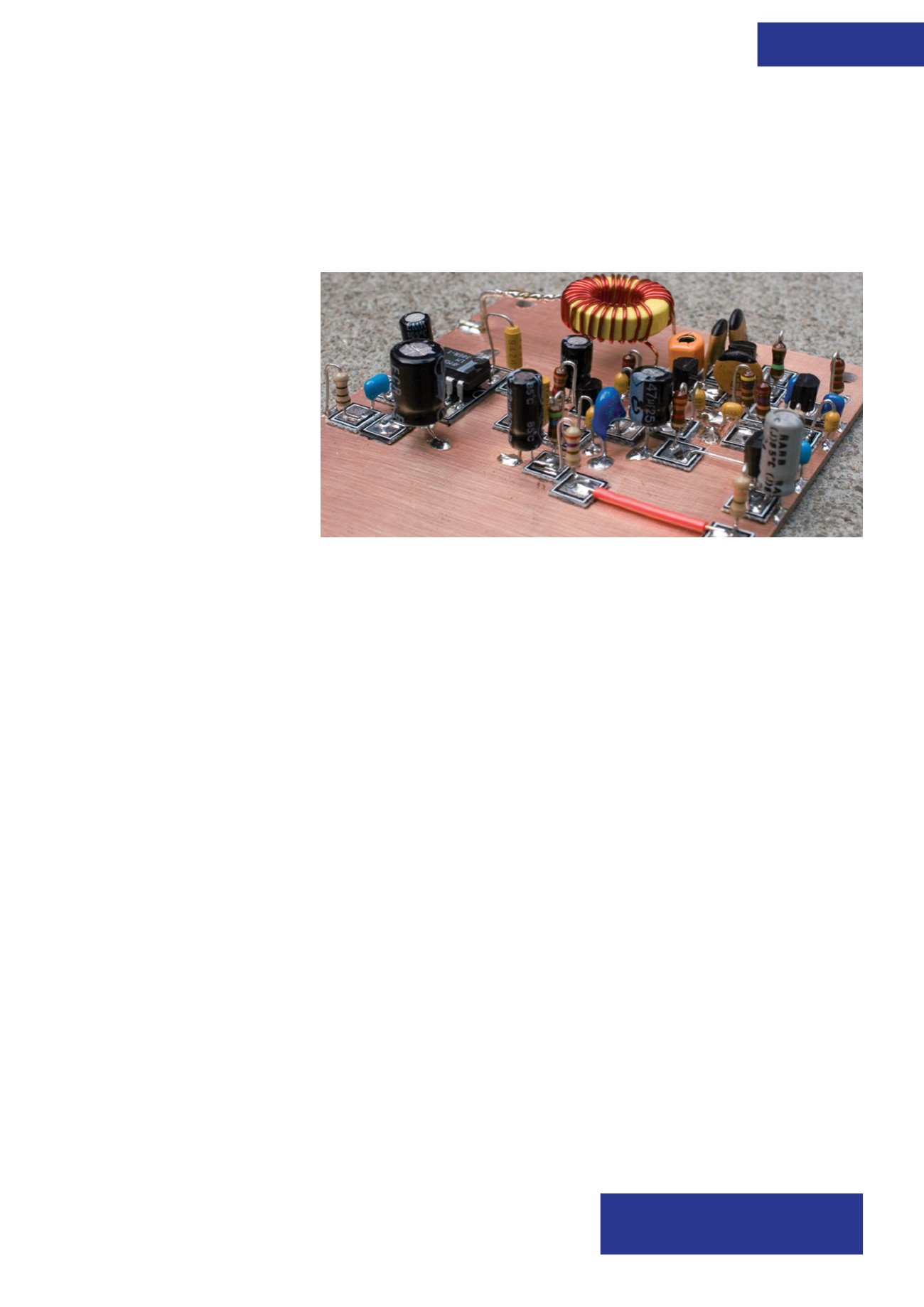
perhaps I ought to mention it again. Copper
‘islands’ are glued on a ground-plane made
from printed circuit board material and these
islands form the interconnection points on
the circuit. The components are mounted
on insulated pads (islands) held on the
ground plane using ‘super glue’. Grounded
connections are wired directly to the ground
plane. The insulated pads can be homemade,
I often use small pieces of printed circuit
board material cut with tin snips, but A7EE
used pads called MeSQUAREs produced by
W1REX of QRPme. See
www.qrpme.comfor
ordering both in and out of the USA.
This construction method is well known,
and commonly used by QRP constructors.
The Americans call it ‘Manhattan
Construction’, the Australians call it ‘Paddy
board’ and there is a commercial version
called ‘Limerick construction’. The origins of
the name Limerick construction come from
Rex, W1REX, the inventor of the idea who
lives in Limerick, Maine. The easiest way to
understand Limerick construction is to look
at the illustrative photographs. There are also
several YouTube videos showing very fine
equipment built using Limerick construction.
QRP
George Dobbs, G3RJV
g3rjv@gqrp.co.ukAn example of construction using copper islands.