


 70 / 100

February 2016
70
VHF/UHF
Regulars
T
he festive season certainly
came
early
for
VHF
enthusiasts
with
major
propagation events during the
monthwith some totally unexpected
contacts.
The 2m UK Activity Contest on 1 December
provided some excellent DX with many
stations working over 1000km into Southern
France and Northern Spain. From this QTH
after chasing locator squares on 2m for 35+
years, JN14 has eluded me. A rather sad
looking, un-coloured square in a sea of red
on my map. I tried a few times via meteor
scatter – actually heard a station in the
square many years ago via tropo – who was
worked by many in the UK but when it was
‘my turn’ faded into the noise with no QSO
completed. JN14 was finally worked with 10
watts in that UKAC not once but three times
(albeit one station was swopping callsigns
during the contest). Excellent DX at 1134km
and a beer to celebrate!
The Geminids meteor shower is an
eagerly anticipated event in December.
Nothing exceptional was reported during the
shower but activity was concentrated further
by the Bavarian Contest Club Meteor Scatter
Contest
[1]
. This long standing event brings
out many big guns and expeditions from rare
locator squares.
Intense auroral propagation also occurred
on 20 December as a double incoming CME
arrived in the late hours of 19 December. By
late afternoon the K Index increased to K7.
The G2 geomagnetic storm, whilst providing
excellent propagation on VHF, also gave a
visual display well down to mid latitudes of
the UK and Europe.
Tony, G4NBS (JO02) took advantage of
the meteor shower peak to do some testing
on 70cm. A QSO was completed with
IK0BZY in JN61GW using the JTMS element
of WSJT. This was Tony’s first attempt on the
band and a sked was arranged for 2000 to
2100UTC. He was pleased to see a ping at
2005 but no useful information apart from
seeing the DF was +395 enabling both
stations to set RITs ‘just in case’. At 2008
Tony had a 320/28 burst with both calls fully
decoded. Then silence in JO02 for a while,
however BZY had a few decodes from Tony
of 80/300 and 800ms. Three tiny pings
followed at Tony’s QTH, all on the correct DF
but not decoded. Luckily, Enrico BZY was
able to extend the sked for 15 minutes and
they were rewarded! At 2017 a 280/3 burst
with fully decoded calls with R27 report and
he even saw his ‘73 Ciao’ message at 2115
at 220/4
[2]
.
John, G4SWX (JO02) says for much of the
period the main 4 x 16 antenna system has
been tied down because of the regular gales
and storms. However John continued with
meteor scatter operations and was also active
in the aurora with a smaller antenna. John’s
log shows that it was a pretty fair auroral
opening but sadly with some ‘gotaways’
including UA3LID (KO64) at 2040km who
was 53A and OH6KTL (KP02) at 1627km
who he could not hear through the wall
of DL stations calling. However two R1
stations, one OH and 7 EU/EV/EW stations
made it an excellent event. The Geminids
shower produced many really intense bursts
with many distant stations being stronger
than 15dB. On MS, QSOs with 9H1CG and
9H1GB (JM75) were over 2000km as were
SV6KRV (KM09) and OH8ETB (KP35) with
the best being UT8AL (KO61) at 2207km.
When the winds were lower and main
antenna system back in operation, EME
was good with TO2EME (FK88), PJ7/PE1L
(FK88) and FH/DL1RPL (LH27) being new
DXCC countries. One really excellent QSO
was with YO6XK (KN25) who was only
running 100W and a 13 element Yagi. 2015
was been a pretty average year with stations
in 76 countries and 398 squares being
worked on 144MHz, the QSOs were 35%
JT65 EME, 32% SSB, 21% CW and 12%
FSK441 MS.
Martin, GM8IEM was lucky to catch the
good auroral opening during the afternoon
of 20 December and chose to stay on 2m
SSB. It can be a more challenging alternative
to using CW due to the Doppler effect on
the signal. Although auroral contacts were
made as early as 1520UTC, the band really
livened up from 1645, and remained open to
1850UTC. In all, 40 QSOs were made into
26 locator squares including 2 new ones in
G, GI, GM, GW, ON, PA and DL. ODX was
DH8BQA (JO73CE) at 1347km.
Lyn, GW8JLY (IO81) reports on a most
remarkable meteor burst that was outside
any notable major meteor shower. “Generally,
sporadic meteor bursts can last around
500ms in duration, therefore MS operators
get quite excited when a burst of several
seconds is copied. During a QSO with OH4LA
in KP20LG at 2000km on 23 November, we
both experienced an amazing burst lasting
for a full 2 minutes and 10 seconds. Not
only was this burst exceptionally long, it was
very strong too and peaked at 16dB. We
easily completed the QSO and continued to
exchange FSK 73s wondering just when the
burst would end. We should have switched
to SSB as soon as we had finished the QSO
but we just didn’t think about it at the time.
It would have been very nice to make a
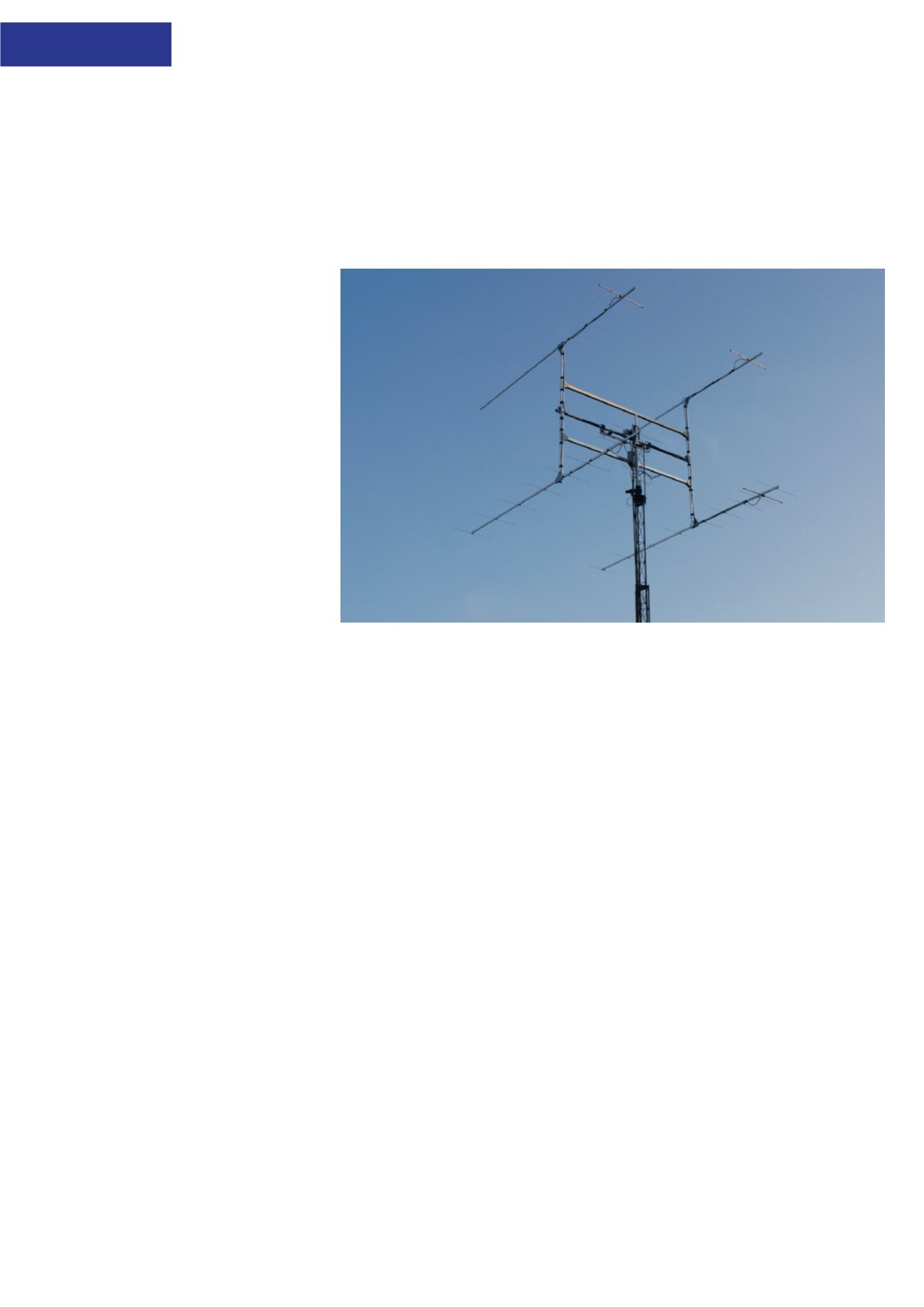
The 4 x 10 element Yagi array using the WAXXX10 design that is at the QTH of Peter, G3MLO.