


 71 / 100

February 2016
71
Regulars
FSK441 MS QSO followed by a SSB QSO
over that distance. I do wonder now if the
burst was from the Leonids shower which
usually has a sharp peak on 17 November.
I noticed several 30 second bursts in the
days following the predicted maximum of
this shower and it could be that the Leonids
were widely dispersed this year as certainly
there was no noticeable peak on the 17th.
The 2m tropo opening was a during the
Marconi CW contest on the morning of 8
November. I could copy CW signals from
all over Germany and the Czech Republic.
Unfortunately I don’t do CW and I had to
use a CW decoder program. As I couldn’t get
the decoder program to TX, no QSOs could
be made. Another opening occurred on 15
November, this time to Spain and EA1 and
EA2 stations were worked. During a contest,
on 1 December the band opened once more.
Stations in the south of France (JN16, 14
and 03) were worked amongst others. The
band was also open to the east with German
stations in locators JO31, JN49 and JN48
together with PA and ON answering my
contest CQ calls. That doesn’t often happen in
the regular 2m UKAC. The Geminids meteor
shower was much better than last year but it
was certainly not one of the best. Between
10 and 15 December, I completed 51, MS
QSOs with the following DXCC: I, DL, HB,
OK, SM, S5, LY, ES ,OH, OE, YL, OZ, YU,
SP, LA and UR. One new locator was worked
during a QSO with OH8K in KP13FA. Only
one of my QSOs was with a station at over
2000km, this was with YL2FZ in KO37QI at
2067km. I tried a number of times near the
peak of the shower to work RU1AA again at
2225km but this time a QSO could not be
completed. I didn’t notice many long bursts
during the shower this year either.”
Station Profile
Peter, G3MLO (JO01) has been QRV on 2m
for a number of years but over the past few
months he has been sending in details of the
home constructed items in his shack and a
excellent 4 Yagi antenna system (
Photo 1
)
to become QRV on moonbounce (EME). In
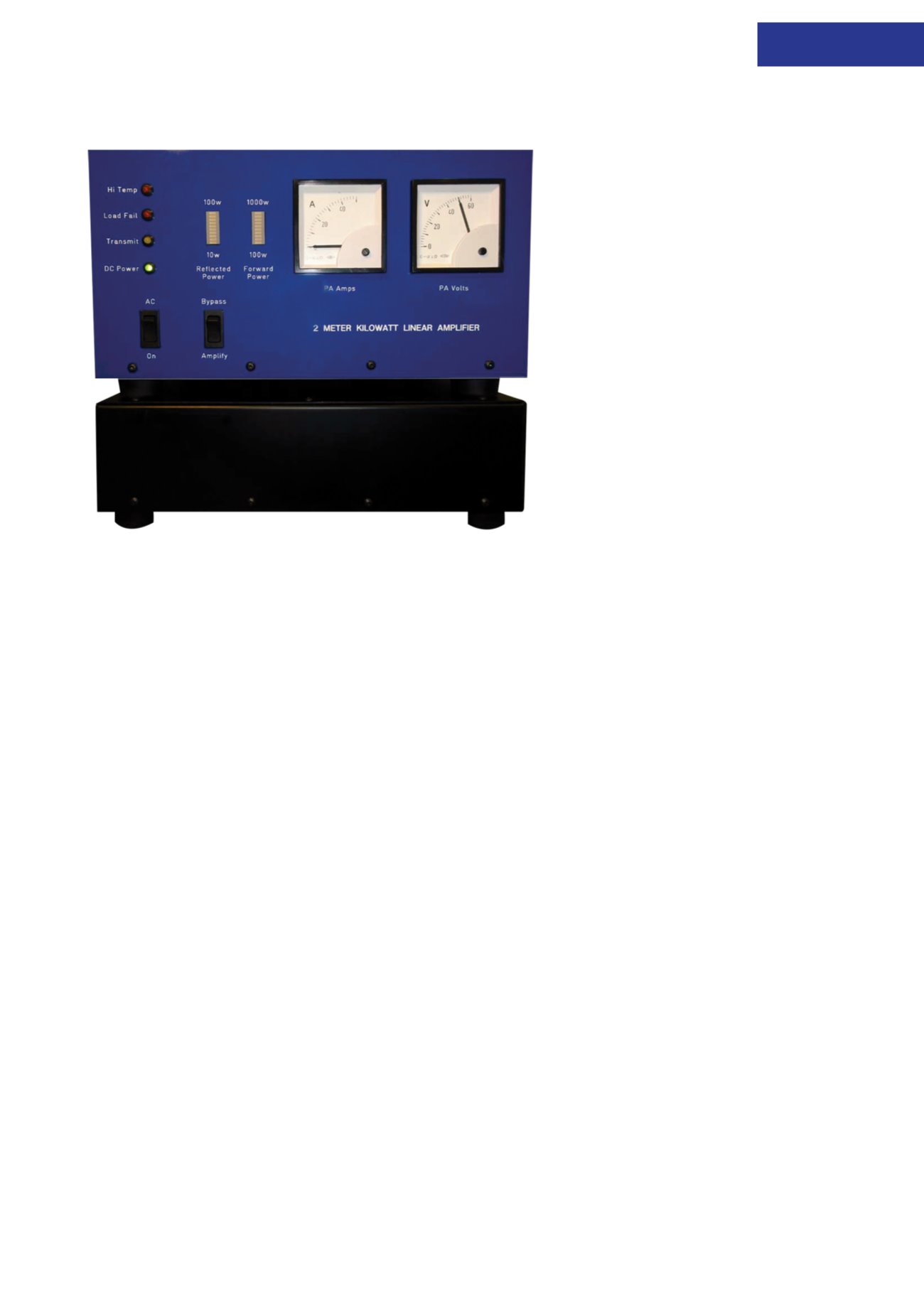
particular there is a high power MOSFET PA
central to the project.
“I am from an engineering background
and do not have much in the way of test gear
– only the essentials for building antennas
and other equipment. I decided to build a
high power LDMOS 2m amplifier from a
well tried and tested design, albeit with a
slight number of variations to the original by
F1JRD (
DUBUS
4/2010)
[3]
. After reading
all I could find on the subject I decided to
use kits from Jim, W6PQL after reading
the article in
QST
October 2012
[4]
. After
looking at the extensive lists of components
etc I decided to purchase a mixture of kits
and ready built items. The 2m RF deck,
the low pass filter/dual directional detector
board and the amplifier control board were
the assembled items. I suggest you to flow
solder the LDMOS device to the copper
heat spreader, giving much better cooling.
I designed and built the enclosure for the
amplifier and the separate power supply
and, as I have access to metal forming and
cutting equipment, this was easy to achieve.
The enclosures takes the form of trays and
using 4mm rivet nuts to form the cabinets,
the front panel was made to order by a local
engraving company (multilayer plastic). The
amplifier worked perfectly when testing, the
only problem I have encountered was the
failure of one of two 50V 20A switch mode
supplies that were operating in parallel.
Although equipped with the balance circuits
connected, one failed. These were of Chinese
origin. I have replaced these with a single
50V 42A SM supply (Mean Well RSP-2000).
The antenna system was decided as a 4 x
10 element Yagi array using the well known
and respected G4CQM WAXXX10 design.
With information taken from the websites of
Derek, G4CQM and Richard, G6HKS, both
of whom gave outstanding advice and tips in
the antennas construction
[5] [6]
.”
What’s On Your PC Screen?
Stations have been asking me ‘how to
anticipate conditions on VHF/UHF’ so they
can try and prepare or monitor such events.
With all the different PC applications to
monitor conditions, including a SDR system,
its is sometimes difficult to manage all the
windows while trying to search for the DX.
Many stations now use two screens to
expand the windows and reduce clutter and
actually concentrate on the main event – to
work DX. Considering applications like DX
Cluster, ON4KST Chat, JT65 EME Chat plus
solar and tropospheric information, how do
you collate all the information into an easily
manageable package? A one stop website
for all things VHF DX has been developed
over many years by the Make More Miles On
VHF (MMMONVHF) team
[7]
. Some of the
tools available are exceptional, particularly
the tropo propagation forecast map that
has been very accurate over the past few
months. Details of expeditions, meteor
and EME data are updated constantly.
After registering with the system, in the
download section a very handy DX CLIENT
which consolidates applications like DX
Cluster/KST/JT65B EME Chat all in one
window. Numerous configuration settings
allow customisation so you can filter out
unwanted DX spots etc.
Sign Off
Thanks to all contributors this month and
looking forward to good DX in 2016.
Websearch
[1]
www.bavarian-contest-club.de/[2]
http://physics.princeton.edu/pulsar/k1jt/doc/wsjt/[3]
www.qsl.net/f1jrd/MRFE6VP61K25H.html[4]
www.w6pql.com/index.htm[5]
http://g4cqm.www.idnet.com/[6]
www.powabeamantennas.co.uk/G6HKS/[7]
www.mmmonvhf.de/The high power MOSFET PA central to the design of Peter, G3MLO’s moonbounce station.