


 73 / 100

February 2016
73
Regulars
W
hat is thought to be
the first ever two way
amateur radio contact
using an unmanned spacecraft as a
passive reflector was completed on
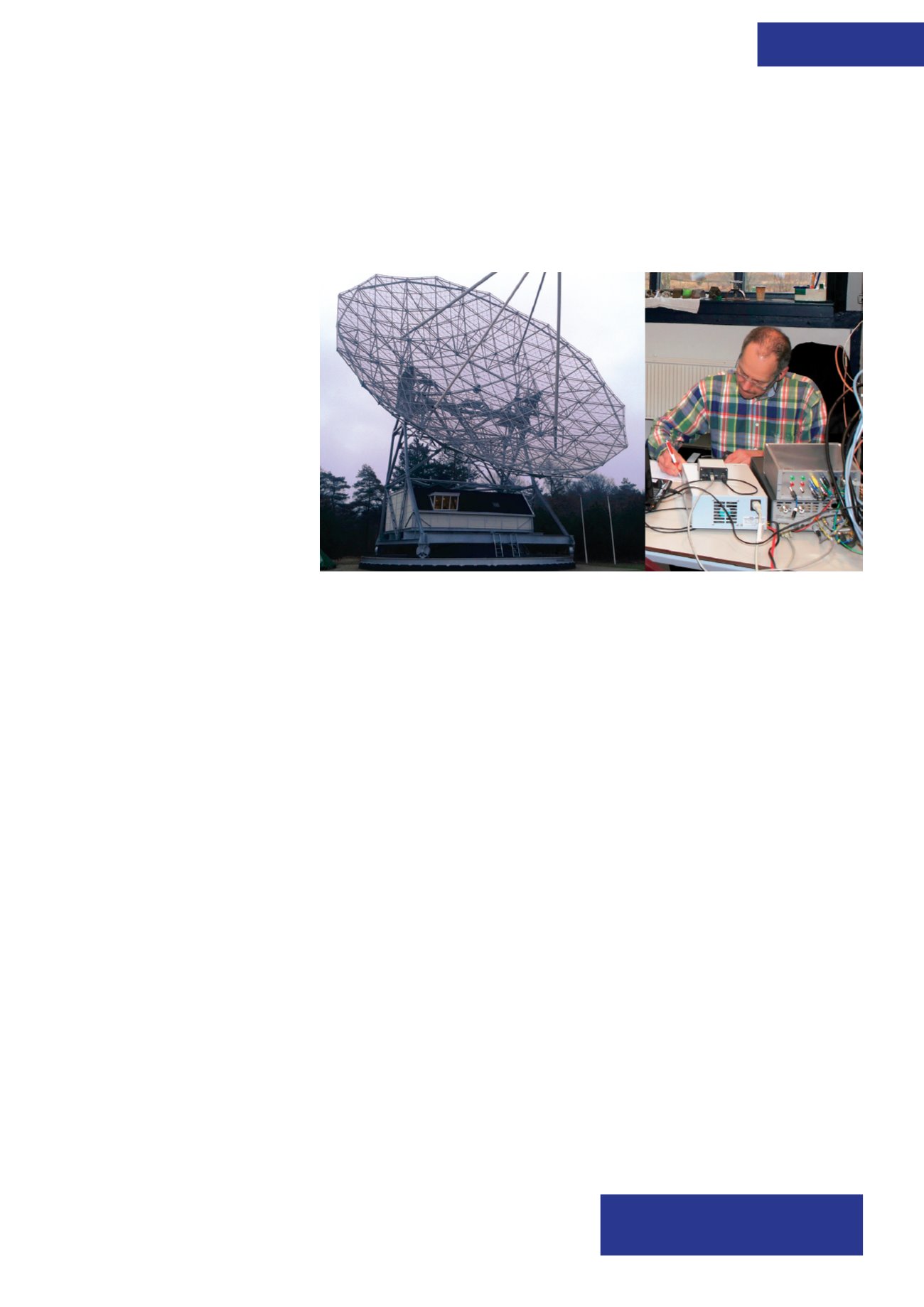
8 December 2015 between PI9CAM
[1] operated by Jan, PA3FXB (Photo
1) and Andreas, DJ5AR. Having
already completed an ‘ISS bounce’
QSO, satellite bounce was a much
bigger challenge.
Despite PI9CAM using the 25m dish at
Dwingeloo it took nearly 2 years, enormous
patience and scores of tests until they finally
managed to receive ‘Rs’ to complete a QSO.
The satellite used was OKEAN-O, a 6.2 ton
joint Russian-Ukrainian Earth observation
satellite, launched in 1999. It is in a polar
orbit of about 650km with an inclination of
98° and has an estimated radar cross section
(RCS) of 18-20m². PI9CAM used 120W at
Dwingeloo and DJ5AR used a 150W to a
3m dish, both operating the new JT9H
WSJT-X mode
[2]
. Transmit/receive periods
were set to 10 seconds, on 1296.300MHz.
Automated Doppler tracking (±60kHz!)
was done by DJ5AR´s homebrew tracking
software. A full report is at
[3]
.
GHz bands at WRC-15
Everything in the 10-76GHz range was
scrutinised at WRC-15
[4]
last November,
in an effort to find a place to put the 5G
future mobile broadband proposals for WRC-
19. Of particular interest was that it was
known for some months beforehand that
Ofcom and CEPT had highlighted the 47GHz
region as insufficiently used. So, despite our
Primary status, it was very exposed. The UK
Microwave team led by Murray, G6JYB spent
much effort making sure we were treated fairly;
all the activity reported here recently should
have helped our case. Despite this, the global
amateur 47GHz allocation was identified as
a possible “additional allocation”. WRC-19
Agenda Item (AI -1.13) specifically considers
adding a Primary mobile allocation for future
5G at 47GHz. As we are already a Primary
User we do have some rights associated with
that, but it doesn’t keep them out. The study
period is underway and will run until WRC-
19, whereupon any mobile allocation would
come into force. Our challenge is to show
that we use and value the allocation, both
terrestrially and for satellites. If we can get a
decent deal and retain some of the band the
reward should be that we also end up with a
lot more commercial bits to play with!
Microwavers need to be ready to defend
this allocation on a global basis as it would
be very unwise to lose a Primary band; we
have so few of them. The only real defence
we have is to show not only that there is
activity, but to show that we are pushing its
technology and propagation characteristics.
If you do make equipment for 47GHz, don’t
just use it as another GHz DX band, try
some short range, indoor or through-building
multipath experiments, try innovative
antennas; not just dishes and horns.
As 47GHz beacons are Primary, get some
spare hardware, and put an application in
for a GB3XXX beacon NoV. It then gets into
the Ofcom database. Don’t keep it to yourself
– publish your work in magazines and on the
web. We really do need to keep up our profile
on these upper GHz bands. At WRC-15, car
radars wanted Primary access to our Primary
77GHz allocation so, as it had dangerous
precedents for other bands, a lot of effort
went into that – with the result that the car
radars are restricted to compatible conditions
and we ended up keeping an allocation.
The challenge at 47GHz will be even more
intense, whether it’s in-band or adjacent to
it, so we need to clearly state how we use the
band to assist compatibility studies.
Some good results did come out of WRC-
15 however. Agenda Item 1.10 dealing
with 22-26GHz was firmly concluded as a
‘No Change’ and this comes as some relief
to the amateur services, with our Primary
allocation at 24GHz untouched. Agenda
Item 1.12 dealing with 10GHz and the EESS
(earth exploration satellite service) accessing
10-10.4GHz leaves the amateur service
unscathed. However the 3.4GHz band is to
become a mobile service Primary allocation
in Region 2 and identified for 5G. We face
further CEPT and WRC-19 studies for Wi-Fi
being extended into our 5.7GHz narrowband
segment. So vigilance and a higher profile
will be key in future. See
[5]
for more detail
of WRC19.
Finally
I’d be interested in your feedback on our new
format and microwave technical features.
The 2016 GHz events calendar is now
online on the UK Microwave Group site
[6]
.
Websearch
[1]
www.camras.nl/index.php?lang=en[2]
http://physics.princeton.edu/pulsar/k1jt/wsjtx.html[3]
www.dj5ar.de/[4]
www.itu.int/en/ITU-R/conferences/wrc/2015/[5]
http://rsgb.org/main/news/special-focus/wrc-19/[6]
www.microwavers.org/events.htmGHz Bands
Dr John Worsnop, G4BAO
john@g4bao.comPHOTO 1:
Jan, PA3FXB at the controls of the Dwingeloo Dish (left). Photo by PE1CHQ.