


 68 / 100

February 2016
68
P
ropagation conditions held
up well in December with
Solar Flux levels above 100
for most of the month and not too
many days of geomagnetic storms.
LF conditions seemed fairly good and
VR2UU in Hong Kong, with QRP into a long
wire, worked a couple of UK stations on 80m
CW around 1900UTC. There may be a dip
in conditions on the higher bands during
January and February but we can expect a
seasonal rise in MUFs for the spring months.
Breaking pile-ups
The first three months of 2016 promise to be
very busy for DXers as numerous expeditions
to most wanted entities are scheduled –
Palmyra K5P and South Sandwich VP8STI
should be starting about now – so it seems
a good time to recap the best way to break
the pile-ups.
Generally the DX stations will be
announcing that they are listening ‘up’ or
will give a listening range like ‘five to fifteen
up’. You can simply choose a spot and call
– and you will probably get through in the
end (especially if you have a linear and/or
a beam). But you will get through faster if
you listen to the pile-up to work out exactly
where the DX station is listening and whether
he is tuning up or down. Ideally you need
a transceiver with two receivers so you can
monitor the DX in one ear and the pile-up in
the other. Flipping between VFO A and VFO
B is almost as good as long as you don’t miss
the completion of the previous QSO – and
this does take some practice. When the DX
station gives a report to someone you need
to tune very quickly across the listening
range in order to find the matching callsign
or more likely just someone giving a report.
You will then be in position yourself for the
next calling moment. If the DX is moving up
or down slightly after each QSO then make
the appropriate adjustment. With a big pile-
up you may only find the calling station one
time in ten but it is still worth trying and you
can still call in random places until you have
a better plan. A lengthy announcement about
callsign, QSL info, IOTA number, etc may be
a sign that the DX is returning to the bottom
of his tuning range.
It is tempting to assume that the pile-up
knows what it is doing and that most of it will
be in the right place but this is not always
the case; quite often the DX station will have
moved to an extreme end (or even beyond
the end) of his announced range. Be alert
for occasional announcements of an exact
listening frequency – not always in English!
If things are really tough (and your software
allows it) then use a band map and enter
the frequency of loud callers. Then, when the
DX goes back to one of them just click on
their callsign and you should be in the right
place. You could also watch the cluster as
some people announce the frequency they
got through on – but the whole pile-up is also
watching, so for a few minutes the spotted
frequency is likely to be the worst place to
call.
December ARRL 10m contest
If you were QRV from the south of the UK
you probably had much better propagation
than those in the north. From Cambridge
things started well with openings to Australia
and most of the equatorial Far East though
I failed to hear any stations from Japan,
Korea or New Zealand. By the afternoon the
band was open to all of South and Central
America but I didn’t hear anything further
north-west than Mexico and Montana.
Sunday started well with a number of VKs
and a long path opening to JA6 around
1100UTC but the band died just after lunch.
Darren, G0TSM, in Southampton with a 5
element Yagi at 45ft heard ZL during Sunday
morning and continued to work the USA
through the afternoon. His best DX though
was on Saturday when he worked FO5RH
in the Tuamotu Islands around 1550UTC.
He also made a number of European QSOs
that were probably long path round the world
judging by the echoes and delays. Nobody in
the British Isles worked Alaska or Hawaii as
far as I know. The afternoon opening to the
Tuamotu (and Pitcairn) area on the higher HF
bands is probably quite common but there is
rarely anyone active at the Pacific end.
North Korea
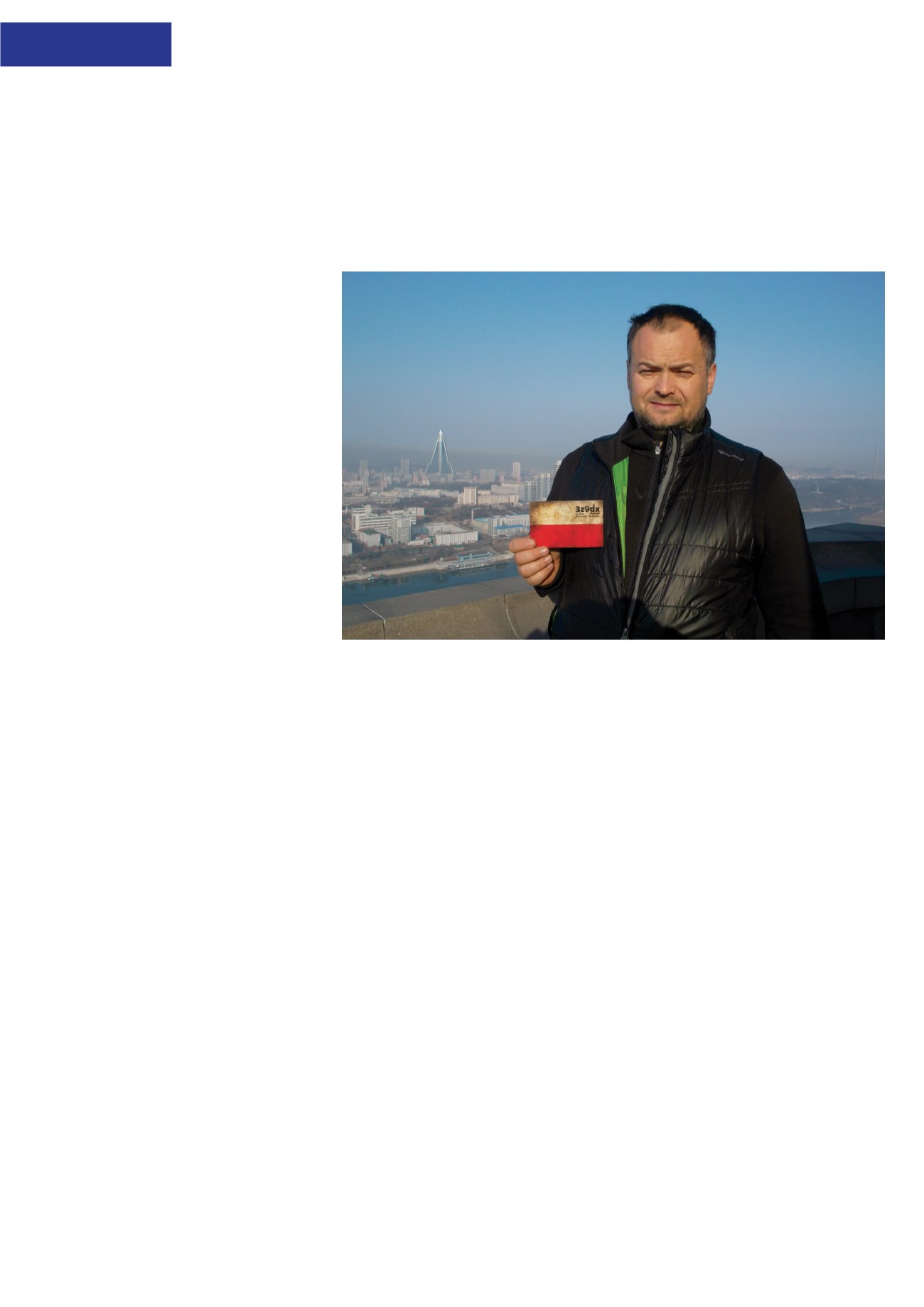
The surprise of December was a short
operation from North Korea by Dom, 3Z9DX.
He was scheduled to be in Pyongyang to
make final arrangements for a 5 day visit in
early 2016 but was able to get on the air for a
couple of days as a demonstration and made
785 QSOs despite S9+ noise levels in the
city. As agreed in advance the North Koreans
retained his transceiver when he went QRT
and DXers are now waiting to hear if he
will return for a longer visit. This may now
happen from a quieter location at the end
of summer 2016. Propagation conditions
and the exact operating times in December
did not favour the UK and no British stations
made it into the log.
HF
Regulars
Dom, 3Z9DX in Pyongyang was a surprise transmission in December.