



 63 / 100

Feature
February 2016
63
On Tuesday 5 January, Verulam ARC,
supported by RSGB Board Director Steve
Hartley, G0FUW, undertook a buildathon at
the school. Twenty-four pupils worked in pairs
to build 12 RSGB/Walford Electronics Rodway
receiver kits and really enjoyed the experience.
The circuit was designed by Tim Walford,
G3PCJ, the PCB by Giles Read, G1MFG with
instructions by Dan Trudgian, M0TGN and
Steve Hartley G0FUW and the RCF sponsored
the kits. A great team effort. The teachers
were impressed by the kit and head Design
& Technology teacher said he was going to lay
on a radio building ‘club’ to build more.
VARC members David, G3YYD, Roger,
G0RBK, David, G4HHJ and Peter, G4HSO
helped the pupils wield their soldering irons
during the activity.
Talking to the ISS
As preparation for the contact with the ISS,
three pupils took the Foundation course
with Verulam ARC in December, passed and
received their callsigns. Jessica, M6LPJ,
Polly, M6POG and Emma, M6GJQ were to
be the lead and back up to handle the contact
between students and Tim Peake on the ISS.
The students, teachers, parents and media
were assembled by 7.30am and there was
an air of excitement in the hall. The ARISS
team had set up the station, web-streaming
equipment, computer links and microphones
(thanks to Noel, G8GTZ, Phil, M0DNY,
Frank, M0AEU, Graham, G3VZV, Howard,
G6LVB, Carlos, G3VHF and Ciaran, M0XTD).
Ciaran led a practice run-through with
Howard playing the part of Tim using a
hand-held to talk to Jessica and the other
students. They got through 15 of the
prepared questions before the expected time
of the pass was over.
The panel of experts – Matt Cosley
QinetiQ; Libby Jackson, UKSA, Sian Cleaver,
Airbus Defence and Space – first spoke about
the route they took to work within the space
industry, then they answered questions from
the audience. One of the most interesting
was ‘what do you hope this mission will
bring to the UK in five years time?’ The
general consensus was that they wanted
this mission to inspire the next generation
to study science, maths as we need more
engineers. The space industry aims to have
100,000 employees by 2030 so, to avoid a
skills shortage, they will need more students
to take up science, maths and engineering –
including the challenge to recruit more young
women into the industry.
As the time of the contact approached, a
video message from Helen Sharman, OBE
was played when she said that “science is
one of the most amazing subjects I know”
and she encouraged the students to make
the most of this opportunity.
At T-20 minutes, Ciaran talked about the
work of ARISS and explained exactly how
the contact would take place. The various
elements were checked (again) including the
feed from the Goonhilly dish tracking the ISS
and the results were shown on a projected
graphic so everyone there could see the
progress of the ISS. At T-2 minutes everyone
was in position and Jessica was ready to
make the call, “GB1SS this is GB1SAN”,
which just resulted in noise. She continued
to call until a faint response was heard but
then, just more noise. Finally after about
8 calls, we could all hear Tim speak quite
clearly, although faint, and you could hear
a sharp intake of breath around the room.
Hugo, aged 12, was the first to ask his
question, “What do you think Isaac newton
would say if he knew that the name of your
mission was based on his book?” and, after a
couple of tries and a change of channel, Tim
was heard clearly. You could see the relief on
the faces of all those in the ARISS team! Tim
said that he hoped Newton would be pleased
to hear that the mission was named Principia
and that he was honoured to be part of it.
Students were able to ask five questions
– ranging from queries about liquid hydrogen
and molecular forces to whether a helium
balloon rises in space – before the seven-
minute call was terminated due to technical
difficulties that are still being investigated.
The team tried several times to re-establish
contact, but it was not to be. Despite that,
Elaine Richards, G4LFM
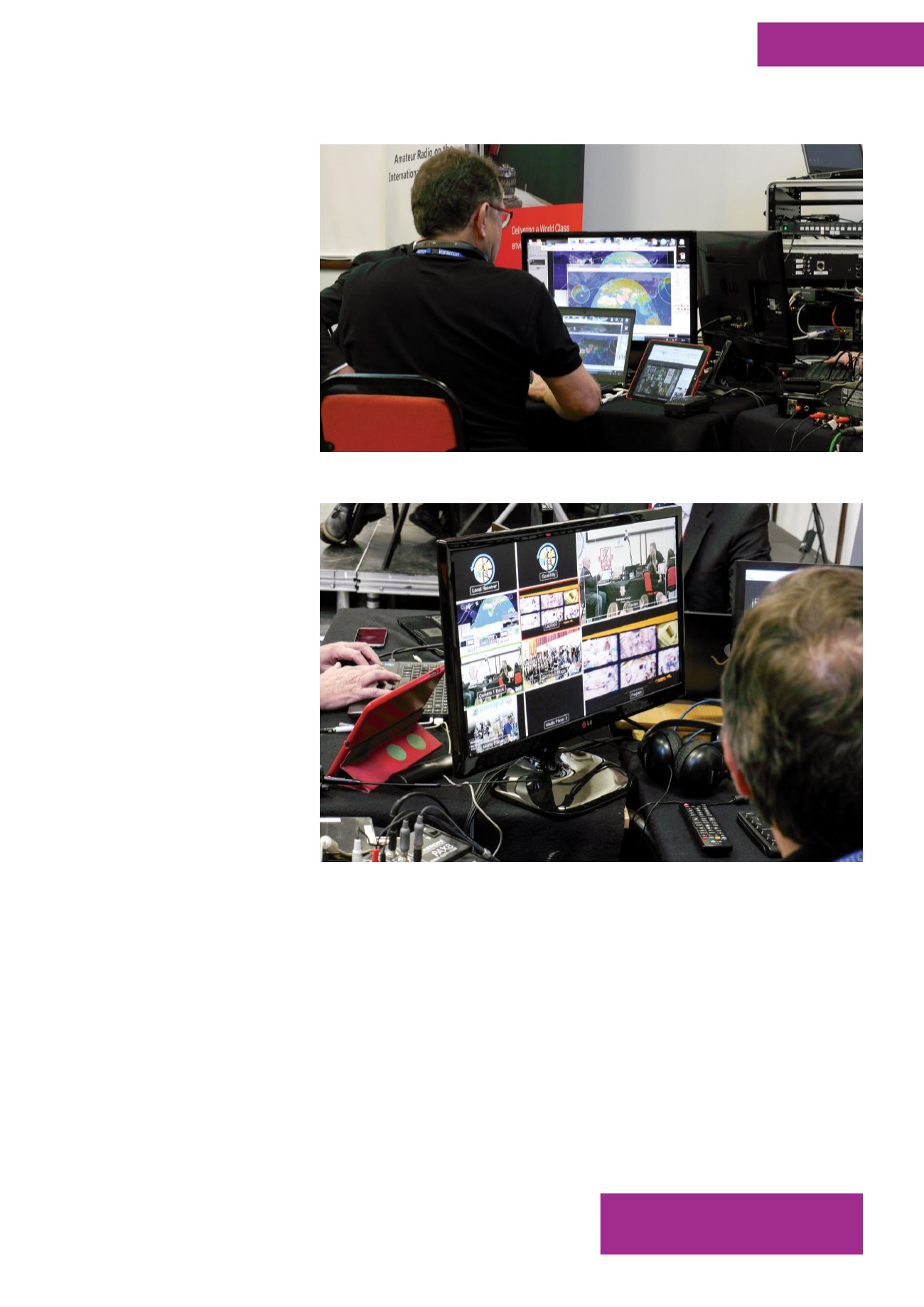
elaine.richards@rsgb.org.ukGraham, G3VZV monitors the communications.
BATC streamed the audio live.