


 64 / 100

February 2016
Feature
64
The questions
1. Hugo (12): What do you think Isaac Newton would say
if he knew that the name of your mission was based on
his book?
2. Imogen (17): If you had a liquid hydrocarbon in space
would the intermolecular forces be strong enough to hold
it in a ball of liquid?
3. Philip (15): How is rapid cooling of liquid metals
performed in the EML experiment?
4. Jess (12): The EML is being used to study alloy structure
and formation. What are the benefits of using space as a
scientific platform?
5. Jamie (18): What would happen to a helium balloon
aboard the ISS?
6. Aiswarya (15): With the EXPOSE-R2 experiment are
you able to predict if any samples will be able to survive
outside in space?
7. Samuel (10): What’s the most exciting thing that’s
happened to you so far on the ISS?
8. Josh (12): With your view of earth, is there one thing
which stands out visually?
9. Liberty (15): We hear that you are planning on driving
the Mars Rover from space, how does that work?
10. Jessica (9): Does gravity affect time and ageing?
11. (Hugo (12): If you could visit any planet in the solar
system (which isn’t gas), which planet would you visit and
why?
12. Imogen (17): How does your body feel when you are
weightless?
13. Philip (15): What did you bring with you to the ISS?
14. Jess (12): Is the sun more powerful in space?
15. Jamie (18): Did you want to be an astronaut when you
were a boy and is it like you thought it would be?
16. Aiswarya (15): As you are communicating with us, do
you get the chance to communicate with your family?
17. Samuel (10): If you could send any message out into
space what would it be?
18. Josh (12): What do you think the hardest adjustment
in coming back down to Earth will be?
19. Liberty (15): What is the most amazing thing you have
seen in space?
20. Jessica (9): Where do you stand on the theory of a
multiverse existence and do you think it is possible to find
any evidence for or against this in space?
history was still made when a British radio amateur (Jessica, M6LPJ)
spoke to a British astronaut on the ISS. Previous British astronauts have
either had US or dual citizenship or been on privately-funded or sponsored
trips, whereas Tim Peake is a European Space Agency (ESA) astronaut.
Following the contact, Ciaran thanked ESA for letting the school be
part of the experiment, Goonhilly and QinetiQ for the Rx link, AMSAT-UK,
RSGB, the school for the space work they had done during the festival,
head teacher Alan Gray and his staff for their enthusiasm and support
and, finally, the students for their dedication to the ISS contact.
The RSGB Youth Chair, Mike Jones, 2E0MLJ, introduced the short
video
Amateur Radio: A Hobby for the 21st Century
that was produced
by TX Factor for the RSGB and is intended as an introduction to amateur
radio for young people. He took the opportunity to talk to the students
about amateur radio and some of the things you can get involved in.
It was a very interesting morning and great to see how the young people
were inspired by the ISS contact. It will very likely produce more amateurs
as at least four young people from Priory School were talking to Verulam
ARC about Foundation courses – a great introduction to amateur radio.
Next schools’ contacts
Between 8 and 14 February, Royal Masonic School for Girls,
Rickmansworth. Between 15 and 21 February, Oasis Academy
Brightstowe, Bristol. Between 22 and 28 February, City of Norwich
Schools, Norwich.
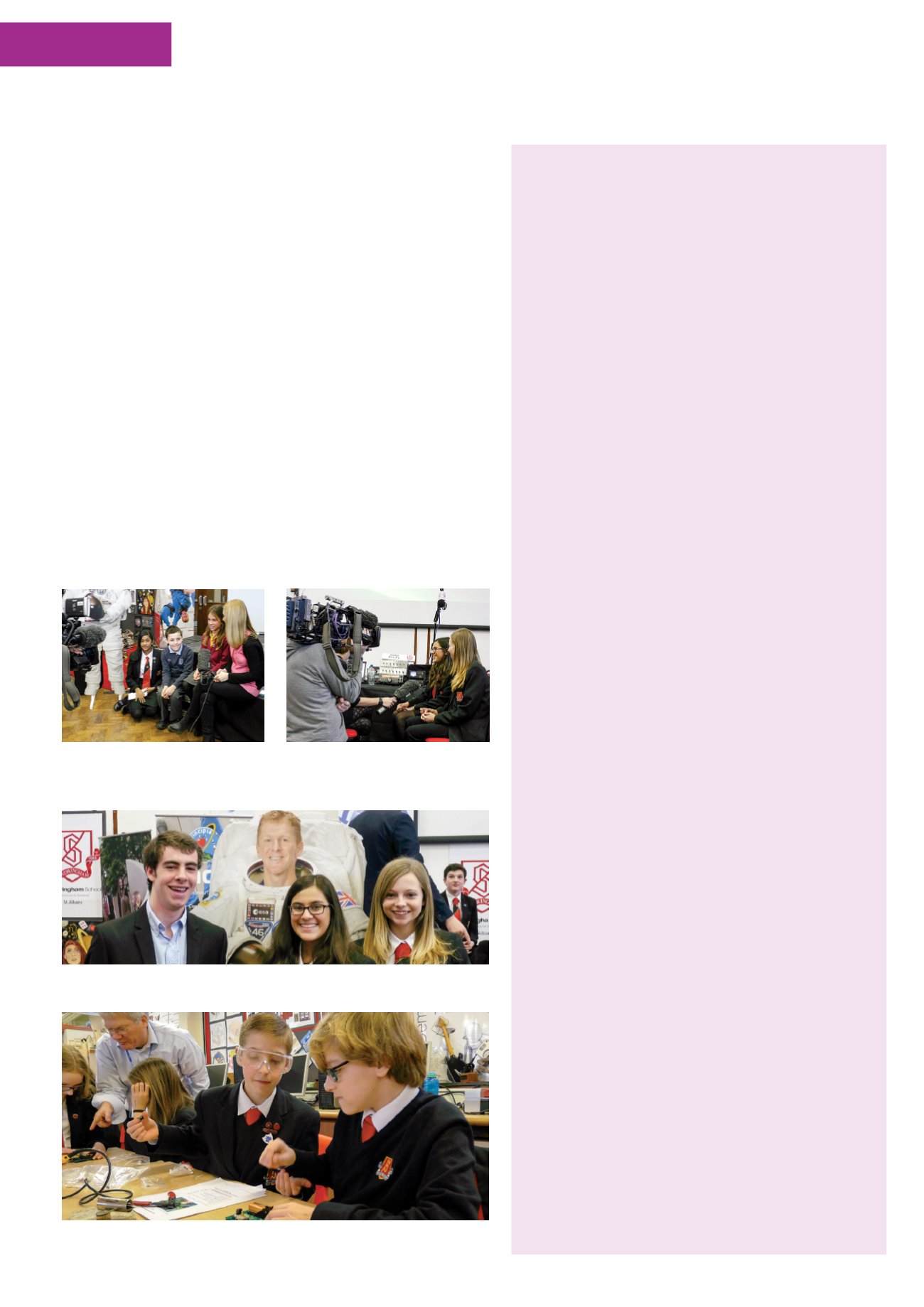
Lots of media attended the event and the students taking part were interviewed
many times during the morning.
Verulam ARC, supported by the RSGB, ran a buildathon during the 4-day Festival
of Space.
RSGB Youth Chair with Polly, M6POG and Emma, M6GJQ