



 45 / 100

February 2016
45
Regulars
have all been known to cause interference
to broadband routers. Keep your router as
far away as possible from other electrical
devices as well as those which emit wireless
signals such as baby monitors etc.”
There are two possible forms of
interference here. The first is interference to
the Wi-Fi link that uses 2.4GHz radio signals.
The other possibility is RF interference
that gets coupled onto the phone line and
interferes with the ADSL/VDSL signals,
typically at MF/HF frequencies. This is what
BT calls Repetitive Electrical Impulse Noise
(REIN), see Websearch. REIN can be caused
by such things as faulty ‘wall wart’ type
switch-mode power adapters, faulty set-top
boxes, televisions, security lights, LED lights
and other appliances. A possible seasonal
source is Christmas tree lights especially if
they flash. Sources outside the customer’s
premises may include street lights, railway
power lines or electric fences.
ADSL and VDSL should be able to
operate as intended when nearby electrical
equipment meets applicable EMC standards.
REIN problems are normally caused by
electrical equipment that is non-compliant
with the EMC Regulations. For example, a
switch mode power supply or LED lighting
where the RF interference suppression
components have failed or were never fitted
in the first place. MIMO PLT could be another
source of REIN even when there is no fault.
In cases of REIN to wired
telecommunication networks such as ADSL
and VDSL, neither BT nor Ofcom has any
power to take action against such faulty
equipment nor to compel the owner to
refrain from using the device. Nevertheless,
if there is also interference to radio services
then Ofcom could take action and it is to be
hoped that they will soon have new Wireless
Telegraphy Act interference Regulations
available to them (see also the April 2015
EMC column). Locating and removing a
source of severe radio interference may
also remove a REIN problem, improving
broad connection speed and reliability for
broadband users nearby.
Solar farms
We have occasional reports from Members in
rural areas that a solar farm is planned nearby
or has been built. Increased noise levels on
the 1.8MHz and 3.5MHz amateur bands
have been reported from a 250kW ground-
mounted solar photovoltaic array, even at
distances of about 500 metres, although
whether these exceed any applicable EMC
standard is another question. We have also
heard of increased noise levels at VHF and
even UHF from certain types of solar farm.
This raises the question of whether it is
considered to be a ‘Fixed Installation’. In the
case of residential solar PV power systems,
Ofcom regards these as ‘apparatus’ rather
than a ‘fixed installation’ for the purposes the
Electromagnetic Compatibility Regulations
2006 (Statutory Instrument number
2006/3418) (the “EMC Regulations”). This
implements an EU Directive (204/108/EC).
According to Ofcom, a residential solar
photovoltaic power system that is comprised
of components that are normally individually
CE marked, commercially available products
intended for the end-user, is not classified as
an EMC installation. It is claimed that if the
panels themselves could be removed from
the property, the system cannot be described
as being intended for use permanently at a
predefined location.
What about a solar farm? Is that a fixed
installation?
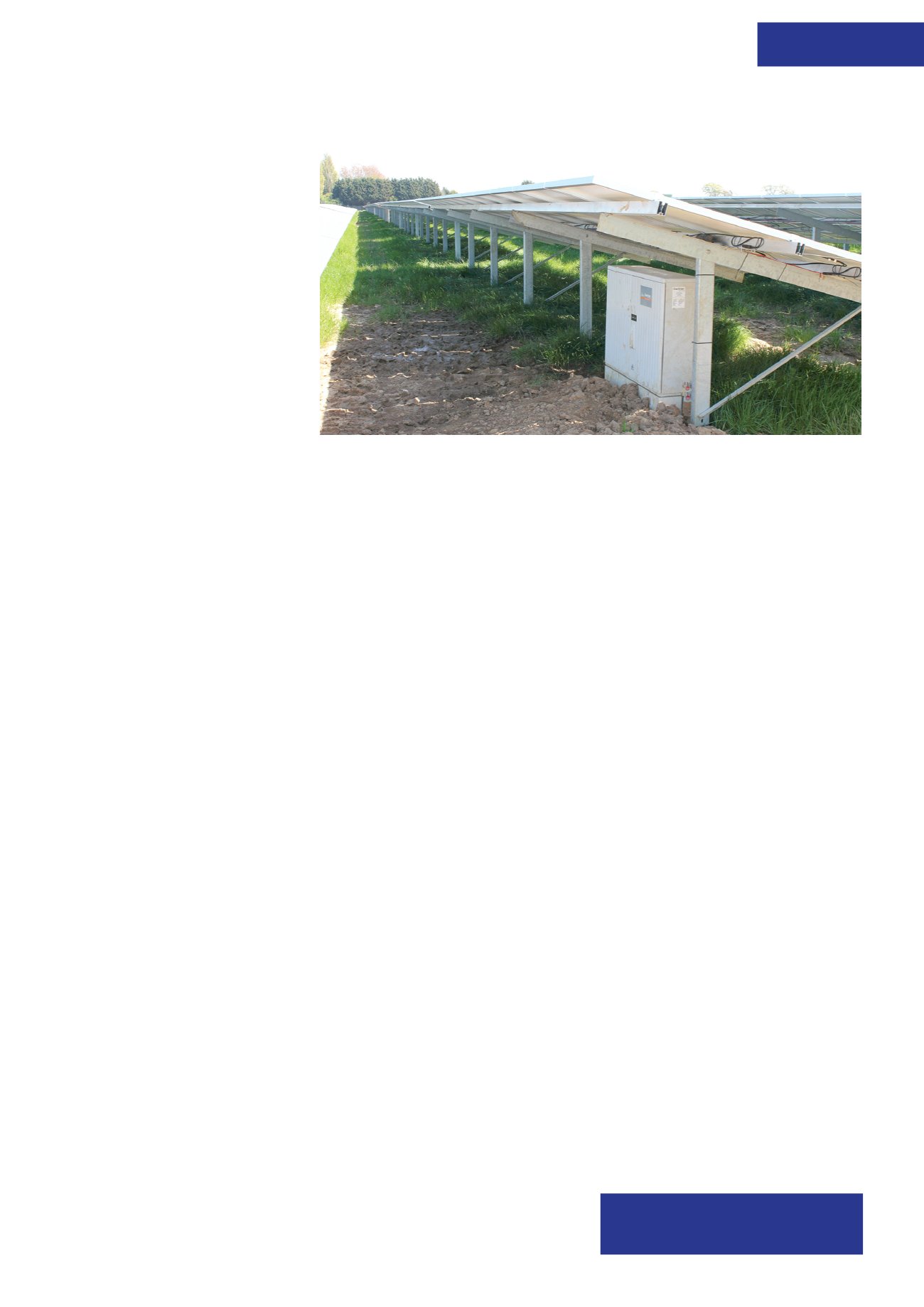
Photo 1
and
Photo 2
show a
typical solar farm, although this is not one
that is known to produce significant RFI.
It may
look
fixed but the EMC Directive
defines a ‘Fixed installation’ as “a particular
combination of several types of apparatus
and other devices [where applicable] which
are assembled, installed and intended to be
used permanently at a predefined location”.
According to the BERR Guide to the EMC
Regulations, there are two important elements
to this: intent and duration. This requirement
for a fixed installation would be fulfilled if it
were intended that the constituent parts were
to be used in the defined location for their
expected lifetime(s). If constituent parts are
expected to be moved during their expected
lifetime to another location, to be taken into
service at that location, the requirement
would not be fulfilled.
It appears that planning permission
for solar farms is typically granted for a
temporary period of 20-25 years, then the
site is restored to agricultural status. In that
case, it might be argued that a solar farm is
not constructed with the intention of being
permanent but if the expected lifetime of the
solar panels and inverters is less than the
period of the planning permission then they
would be used in the defined location for
their expected lifetime(s) so that would meet
the requirements for a ‘fixed installation’.
One consequence of being a ‘fixed
installation’ is that while there are no
conformity assessment or CE marking
requirements, it needs to be installed by
applying good engineering practices and
respecting the information on the intended
use of its components, with a view to
meeting the Essential Requirements of
the EMC Regulations. These Essential
Requirements apply to the installation
rather than individual components and they
include, “The electromagnetic disturbance
it generates does not exceed a level above
which radio and telecommunications
equipment or other equipment cannot
operate as intended”.
One consequence of not being a ‘fixed
installation’ is that the individual components
need to be CE marked and it might be
assumed that the whole installation meets
the Essential Requirements. What about
cumulative effects? The EMC standards only
apply to a single item but a typical solar
farm may have hundreds of solar panels
and possibly hundreds of optimisers with a
smaller number of large inverters. Are solar
farms ‘fixed installations’? Watch this space!
WEBSEARCH
Ofcom Wi-Fi checker:
http://consumers.ofcom.
org.uk/news/ofcom-launches-wifi-checker/
Repetitive Electrical Impulse Noise (REIN):
www.kitz.co.uk/adsl/rein.htmDr David Lauder, G0SNO
emc.radcom@rsgb.org.ukPHOTO 2:
An inverter cabinet in a typical solar farm.