


 43 / 100

 www.kenwoodcommunications.co.uk
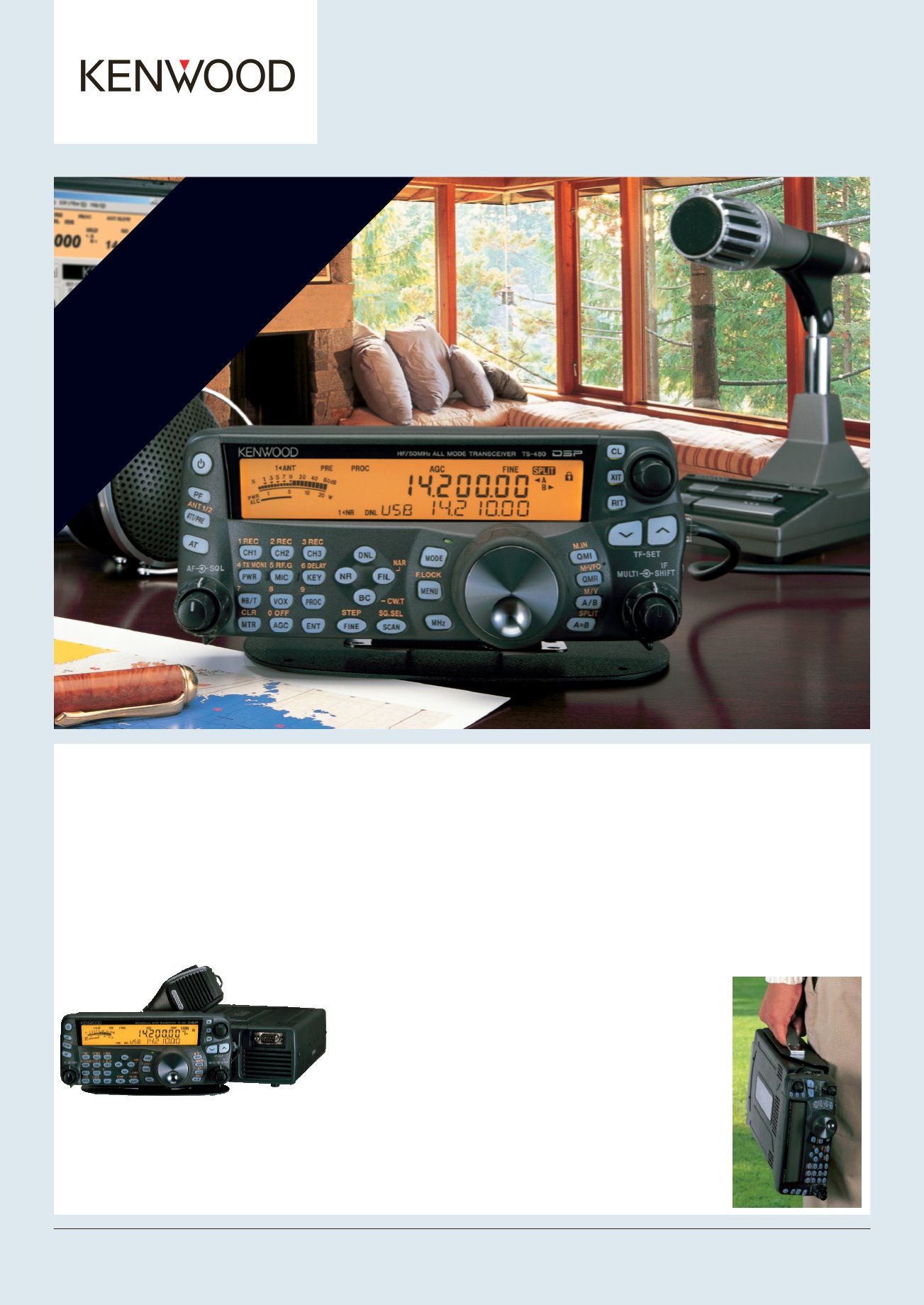
Unique concept, brilliant execution. Kenwood’s compact TS-480HX/480SAT is tailor-made for DX’ing. But its smartly designed standalone LCD
control panel — featuring backlit keys to enhance operating ease — is equally at home on your desk, with the main unit up to 4 metres away.
And wherever it is, this HF transceiver delivers an astonishing punch: 200W. Performance is equally impressive. For example, a quad-mixer
provides RX dynamic range in the TS-950 class, while AF DSP processing offers many powerful features, including noise reduction, a speech
processor, and AF filters. And of course you can enjoy all of the convenience of PC-based control. The TS-480HX/480SAT lets you enjoy the best
of both worlds.
TS-480SAT
100W Model with Built-in Antenna Tuner
HF/50MHz ALL-MODE TRANSCEIVER
n
200W output (50MHz: 100W) DC 13.8V operation
n
100W model available with built-in antenna tuner
n
TX/RX AF DSP
n
Compact construction for easy carrying
n
Separate LCD control panel with speaker
n
Continuous RX: 500kHz (VFO: 30kHz) to 60MHz
n
TX: covers all Amateur bands 1.8MHz to 50MHz
●
Built-in automatic antenna tuner (100W model)
●
Terminals for external antenna tuner, linear amp, PC
●
Electronic memory keyer
●
AF DSP features:
●
AF DSP filters
●
Beat-cancel, noise reduction
●
TX/RX equalizer
●
CW auto-tune
●
Speech processor
●
Optional 500Hz/270Hz band CW narrow IF filters, 1.8kHz band SSB narrow
IF filter
●
PSK31 compatible
●
5W minimum RF output, QRP compatible
●
Electronic keyer
●
Plug-in voice recording/synthesis unit available
●
Packet cluster tune with
TM-D710E & TM-D700E
●
Supplied with mobile panel bracket, tabletop panel bracket and carrying brackets
TS-480HX
200W Model
VoIP INTERNET operation
with optional Kenwood Network
Command software
*Alterations may be made without notice to improve the ratings or the design of the transceiver.
*The photographic and printing processes may cause the coloration of the transceiver to appear different from that of the actual transceiver.